


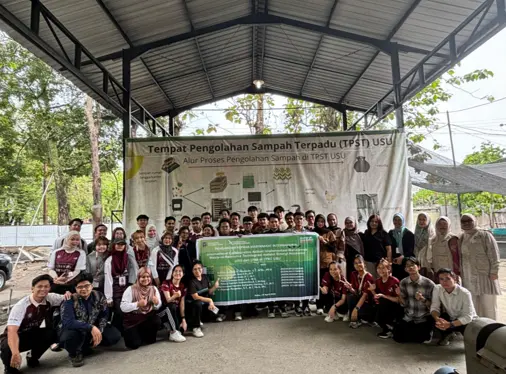
The International Community Service Program entitled International Collaborative Action: Implementing Integrated Waste to Resource Management through Academic Collaboration between USU and USM at the USU Integrated Waste Management Facility was conducted through cooperation among the Master of Civil Engineering Program, the Doctoral Program in Civil Engineering, and the Bachelor of Civil and Environmental Engineering Program at Universitas Sumatera Utara, together with the School of Housing, Building and Planning, Universiti Sains Malaysia, particularly the Quantity Surveying Programme. The activity implemented by the lecturers also involved undergraduate, master’s, and doctoral students from the Civil Engineering programs at Faculty of Engineering USU as part of an experiential learning process that connected academic knowledge with practical sustainability challenges.
The program reflects a shared commitment to strengthening campus waste management through a more sustainable, educational, and value oriented approach. The USU Integrated Waste Management Facility served as a practical learning environment where participants could observe, discuss, and evaluate the implementation of the waste to resource concept. This concept encourages a shift from viewing waste solely as an environmental burden toward recognizing it as a recoverable resource that may be transformed into products or materials with economic, social, and ecological value.
The activity was carried out through participatory, educational, and collaborative methods. The program included expert presentations, interactive discussions, field observation at the USU Integrated Waste Management Facility, identification of development opportunities, and the preparation of recommendations in order to strengthen integrated waste management practices. The involvement of the School of Housing, Building and Planning at USM added an international and interdisciplinary dimension by introducing the perspective of quantity surveying, particularly in relation to resource efficiency initiatives.
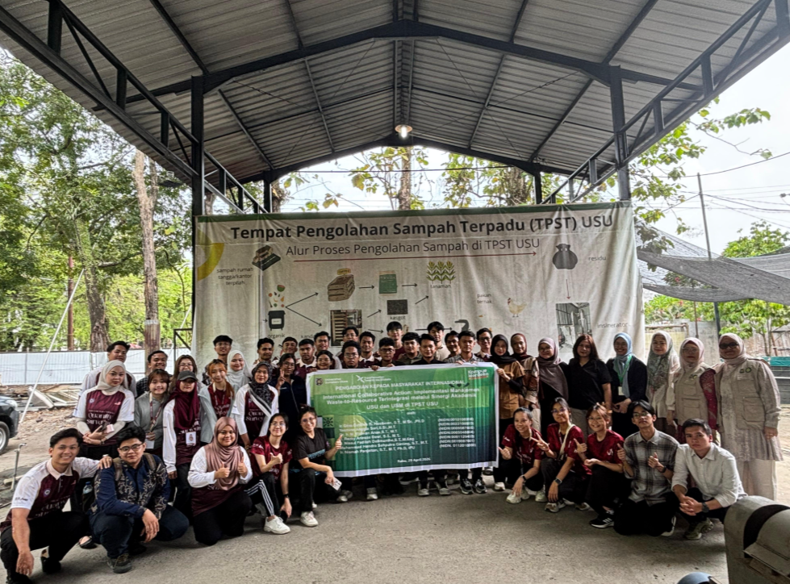
The participation of undergraduate, master’s, and doctoral students from USU further strengthened the academic impact of the program. Students were involved not only as participants, but also in field observation, problem identification, analytical discussion, and the formulation of recommendations. This multilevel engagement reinforced the integration of education, research, and community service while improving students’ understanding of resource management, sustainable construction, circular economy, and environmental responsibility.
The program primarily supports SDG 12, Responsible Consumption and Production, through waste reduction, resource recovery, and the application of circular economy principles. It also contributes to SDG 4, Quality Education, through practice based and collaborative learning; SDG 11, Sustainable Cities and Communities, through the promotion of sustainable waste management; and SDG 17, Partnerships for the Goals, through institutional collaboration between USU and USM in sustainability education and international community engagement.