


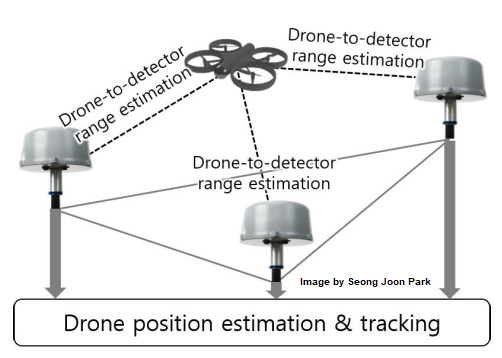
Drone applications extend beyond military purposes and are widely utilized in various fields, such as fertilizer distribution in agriculture, animal monitoring in farming, and even recreational activities. However, the rapid development of drones compared to regulations has led to potential misuse, such as unauthorized drone usage in airfields, public institutions, or privacy violations. This situation has prompted the development of anti-drone technology to address the adverse effects of improper drone usage.
Anti-drone technologies involve several methods, including:
- Detection, utilizing radar, thermal detectors, acoustic detectors, hybrid systems, optical radar/cameras, or radio signal receivers.
- Identification, using RFID and image processing.
- Tracking, involving path estimation, optical flow-based tracking, and automatic dependent surveillance-broadcast (ADS-B) systems similar to air traffic control.
- Neutralization, through techniques like jamming, hijacking, and capturing.
Jamming aims to disrupt communication by interfering with RF signals, including spoofing, geofencing, directional/omnidirectional jamming, stationary jamming, narrow/wide jamming, and GPS jamming. Hijacking involves taking control of drones by breaking their codes or jamming basic signals. Another approach is the killer drone, which uses intercepting drones equipped with flight path estimation. Drone capturing can also be achieved through aerial capture systems, such as net bullets or other net-based projectiles. Additionally, laser systems are available to disable drones.
Related Publications by Universitas Sumatera Utara’s Department of Electrical Engineering:
- Nasution, T.H., Andayani, U., Syahputra, K.A., Fahriza, M.A., Design of fixed-wing unmanned aircraft for monitoring, 2020 4th International Conference on Electrical, Telecommunication and Computer Engineering, ELTICOM 2020 - Proceedings, 2020, pp. 229–232, 9230525.
- Suherman, S., Putra, R.A., Pinem, M., Ultrasonic Sensor Assessment for Obstacle Avoidance in Quadcopter-based Drone System, MECnIT 2020 - International Conference on Mechanical, Electronics, Computer, and Industrial Technology, 2020, pp. 50–53, 9166607.
- Suherman, S., Ananda, R., Pinem, M., Environmental Sensor Assessment for a Light Quadcopter Drone, IOP Conference Series: Materials Science and Engineering, 2020, 851(1), 012017.
- Tarigan, A.P.M., Suwardhi, D., Fajri, M.N., Fahmi, F., Mapping a volcano hazard area of Mount Sinabung using drone: Preliminary results, IOP Conference Series: Materials Science and Engineering, 2017, 180(1), 012277.
- Fahmi, F., Trianda, D., Andayani, U., Siregar, B., Image processing analysis of geospatial UAV orthophotos for palm oil plantation monitoring, Journal of Physics: Conference Series, 2018, 978(1), 012064.
- Nasution, T.H., Siregar, I., Yasir, M., UAV telemetry communications using ZigBee protocol, Journal of Physics: Conference Series, 2017, 914(1), 012001.