


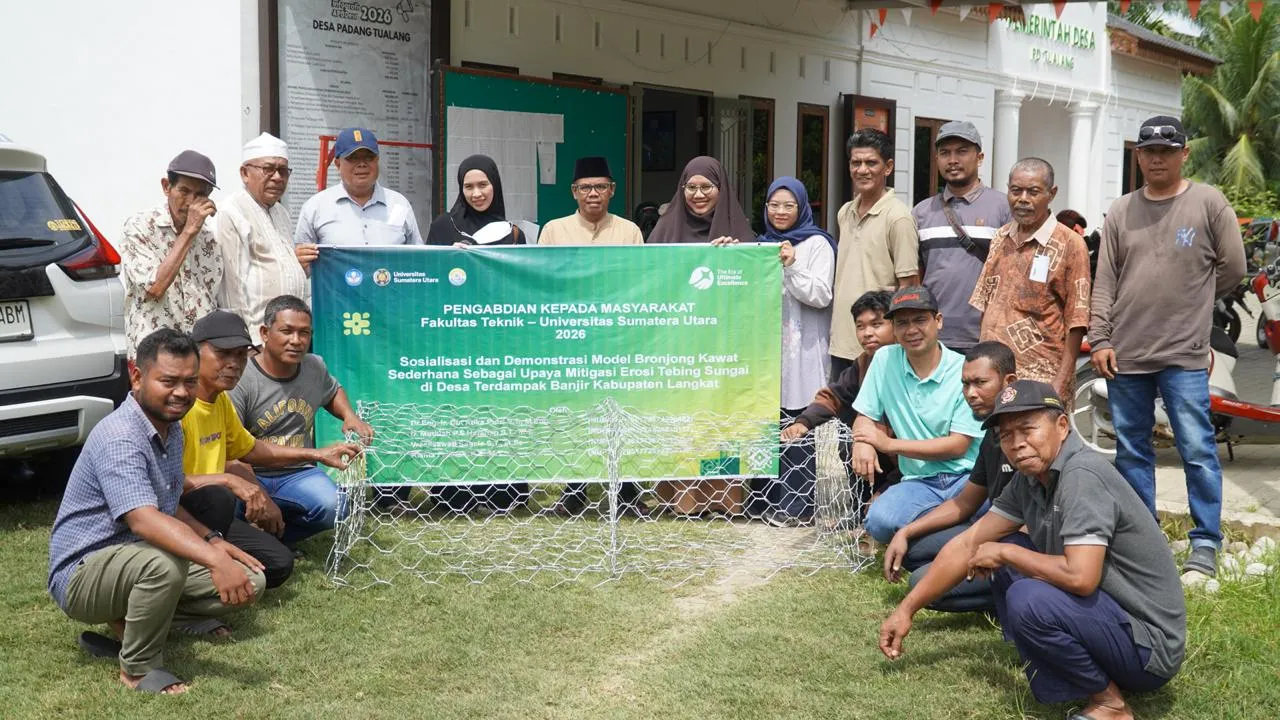
The implementation team consisted of Dr.Eng. Ir. Cut Atika Putri, S.T., M.Eng., Ir. Muthiah P.S. Harahap, S.T., M.T., Vreslisawati Sagala, S.T., M.Sc., and Ir. Risma Fazillah, S.T., M.T.
The socialization activity was prompted by conditions of high rainfall, which can increase river discharge and trigger recurring floods. Strong water currents have the potential to erode the base of riverbanks, reduce soil stability, and threaten land and buildings located around riverbanks.
Through this activity, the community was introduced to wire gabions, which are wire mesh baskets filled with stones and then arranged and connected into a single structure. These structures can be used to help protect riverbank sections that are vulnerable to erosion caused by water currents.
The socialization materials explained that gabions can help dissipate flow energy, slow down currents, and reduce riverbank erosion. The arrangement of stones in gabions also provides protection for the riverbank surface, while the gaps between the stones still allow water to flow, thereby helping to reduce pressure on the soil.
In addition to the presentation, the activity included a demonstration of a simple model illustrating the stages of gabion construction. The process involved preparing the wire mesh, binding tools, and filling stones, followed by filling the baskets with stones and connecting the gabion structures. Safety aspects and river conditions were also taken into consideration before construction work was carried out.
The community was also introduced to several alternative wire materials, such as galvanized wire, zinc-aluminum wire, and PVC-coated wire, as well as types of filling materials, including large stones, river stones, and hard concrete fragments that are not easily broken down by water currents. Material selection is an important aspect of ensuring that gabions are suitable for the environmental conditions at the installation site.
The approach through socialization and demonstration is expected to provide a more practical understanding of riverbank erosion mitigation. Simple gabion models also have the potential to involve community participation in environmental protection efforts, including as an alternative for addressing certain conditions.
This activity primarily supports SDG 11 – Sustainable Cities and Communities through improving community resilience to environmental risks and disasters. SDG 13 – Climate Action is also relevant through strengthening adaptation efforts to the impacts of floods and erosion, while SDG 15 – Life on Land relates to protecting land around riverbanks.
Through its community service activities, the Faculty of Engineering, Universitas Sumatera Utara, continues to encourage the application of simple and relevant engineering knowledge that can support increased community preparedness in addressing environmental issues in their respective areas.