


.webp)
STABAT, OCTOBER 19, 2026 — The Langkat Regency Government, through the Department of Culture and Tourism, held the Initial Focus Group Discussion (FGD) for the Preparation of the Regional Tourism Development Master Plan (RIPPARDA) Study for Langkat Regency 2026–2045. The event, which was opened by the Regional Secretary of Langkat Regency, H. Amril, S.Sos., M.AP., representing the Acting Regent of Langkat, Tiorita Br. Surbakti, S.H., took place in the Main Hall of the Langkat Regent's Office. The event was held as the Langkat Regency RIPPARDA Regional Regulation for the 2020–2025 period had reached the end of its validity. This strategic step was taken to prepare a comprehensive, well-directed, and legally certain long-term tourism planning document.
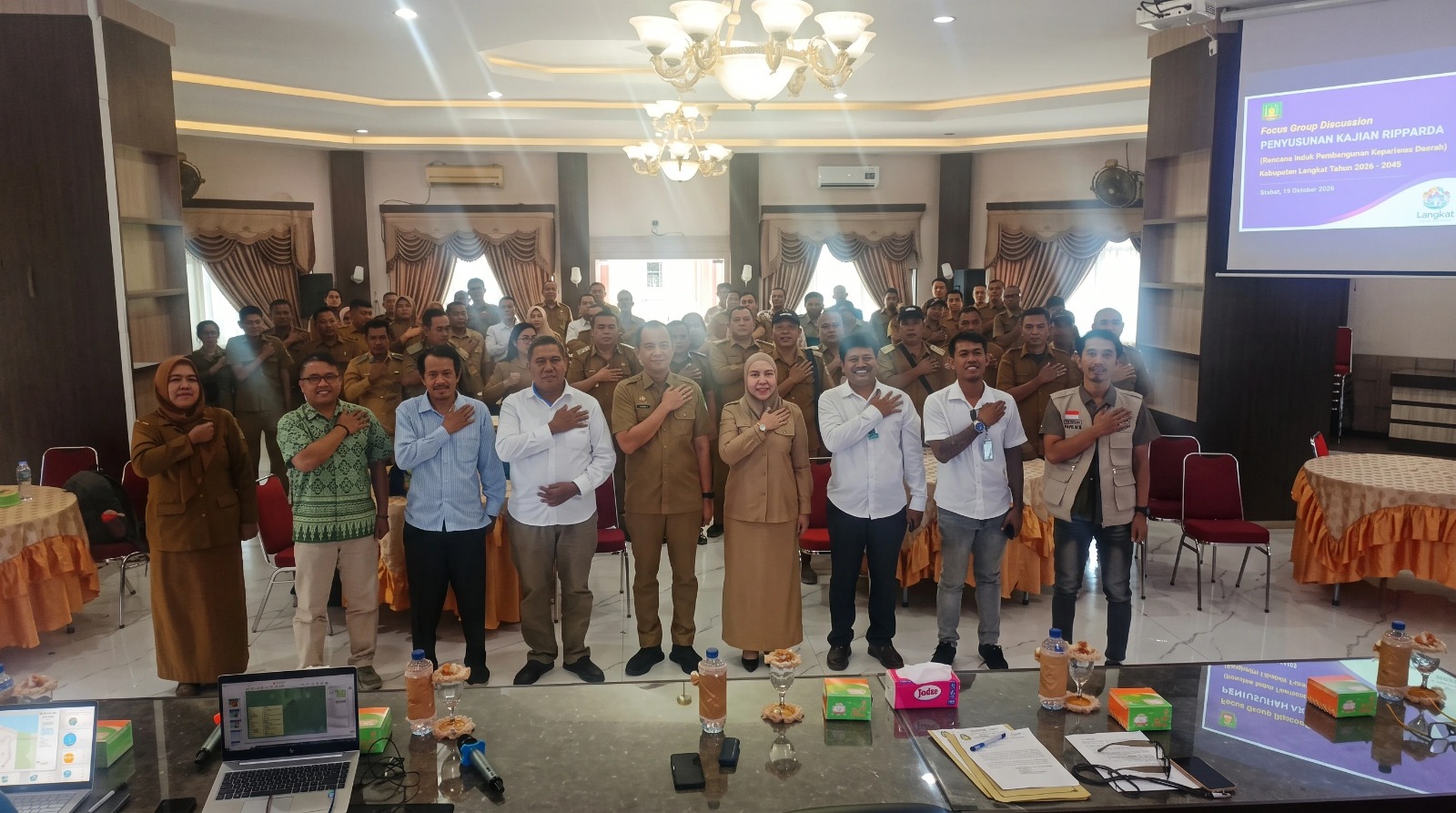
The event featured comparative expert and scientific insights from FT USU spatial planning and tourism expert Dr. Anthoni Veery Mardianta, S.T., M.T., IAP. In addition to actively teaching at the Undergraduate Program in Urban and Regional Planning (PWK), Dr. Anthoni also serves as Coordinator of the Research Group on Governance at USU's Center of Excellence for Sustainable Tourism Science and Technology. His presence provided in-depth insights into the synchronization of spatial planning and the strengthening of tourism governance in Langkat Regency.
In his presentation, Dr. Anthoni delivered a critical evaluation of the previous Langkat RIPPARDA document. He highlighted several issues, including the need to adjust the planning period in accordance with Minister of Tourism Regulation No. 10 of 2016, which requires RIPPARDA documents to cover a long-term period of 15 to 25 years, aligned with the Regional Long-Term Development Plan (RPJPD) and the Regional Spatial Plan (RTRW). Furthermore, the pillars of physical development or destinations, industry, marketing, and institutions need to be organized and incorporated in a balanced manner into the forthcoming RIPPARDA. Dr. Anthoni also emphasized the importance of an adequate carrying capacity assessment in developing tourism areas, particularly those associated with conservation areas such as Gunung Leuser National Park, including the Bukit Lawang and Tangkahan tourist destinations.
In response to these challenges, Dr. Anthoni emphasized the importance of a paradigm shift in tourism after 2025. Langkat Regency was encouraged to move away from a focus on mass tourism and transition toward regenerative and eco-tourism. Tourism policy for 2026–2045 will focus on four main pillars: strengthening ecologically oriented destinations, empowering the local economy through Community-Based Tourism (CBT) and Village-Owned Enterprises (BUMDes), promoting responsible marketing through education on tourist codes of conduct, and establishing collaborative cross-sectoral institutions.
At the end of the session, Dr. Anthoni emphasized that the transformation of tourism in Langkat Regency must always be linked to efforts to achieve the Sustainable Development Goals (SDGs). The implementation of ecotourism and carrying capacity limits in the Gunung Leuser National Park area supports SDG 15 (Life on Land) and SDG 13 (Climate Action). Community-based economic development through tourism villages aligns with SDG 8 (Decent Work and Economic Growth) and SDG 12 (Responsible Consumption and Production). Meanwhile, integrating spatial planning with the RTRW and fostering interinstitutional collaboration represent concrete contributions to SDG 11 (Sustainable Cities and Communities) and SDG 17 (Partnerships for the Goals), with the aim of creating sustainable tourism in Langkat Regency that improves community well-being.