


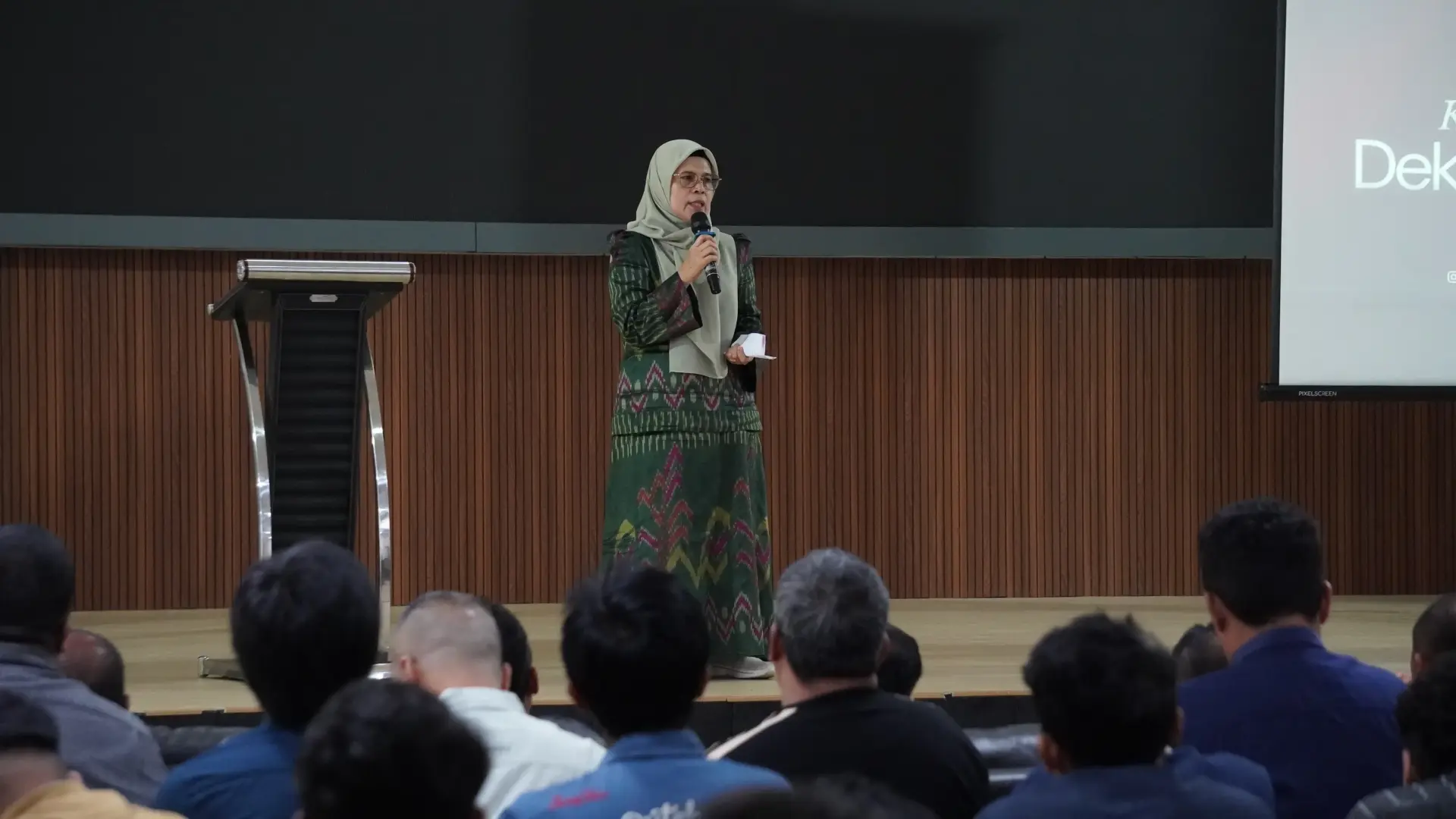
In an opinion article entitled “When Waste No Longer Ends Up in Landfills: Harnessing Energy from Plastic Waste and Coffee Grounds,” Prof. Dr. Ir. Renita Manurung, M.T. discusses research by a Universitas Sumatera Utara (USU) team on the utilization of plastic waste and coffee grounds. The team she led received funding through the 2025 BIMA Doctoral Dissertation Research Grant Program for research by a doctoral student to be completed in 2026.
This development is a continuation of previous research that produced a microwave-assisted pyrolysis machine. Testing was conducted to determine the appropriate waste mixture composition, heating power, and operating conditions so that the resulting products would have better quality. This stage is important because technology development does not stop at proof of concept but requires performance and consistency testing to determine optimal operating conditions.
The pyrolysis process in the research was directed at producing three groups of products: pyrolysis oil, biochar, and gas. Pyrolysis oil has the potential to be utilized as a raw material for industrial needs, with its characteristics being developed toward equivalence with diesel fuel. Biochar has the potential to be utilized as an adsorbent for pollutants, while the gas produced from the process can be reused as a heat source. Through this approach, the research is not only oriented toward converting waste into oil but also seeks to utilize various products generated from the waste processing process.
This approach demonstrates the principle of a circular economy by positioning waste as part of the value chain rather than merely as residue that ends up in landfills. However, the opinion emphasizes that laboratory results do not mean that the technology is ready for mass implementation, as large-scale efficiency, costs, product consistency, emissions, safety, and economic feasibility still need to be assessed.
This idea primarily supports SDG 12—Responsible Consumption and Production through the reuse of waste. The potential of alternative energy sources is related to SDG 7—Affordable and Clean Energy, while the development of pyrolysis technology supports SDG 9—Industry, Innovation, and Infrastructure; all of these contributions remain positioned as research potential.
The Faculty of Engineering USU is committed to encouraging research that connects laboratory innovation with energy and environmental challenges. Further development, comprehensive testing, and collaboration with communities and industries are needed so that the technology can move toward efficient, safe, economical, and sustainable implementation.