


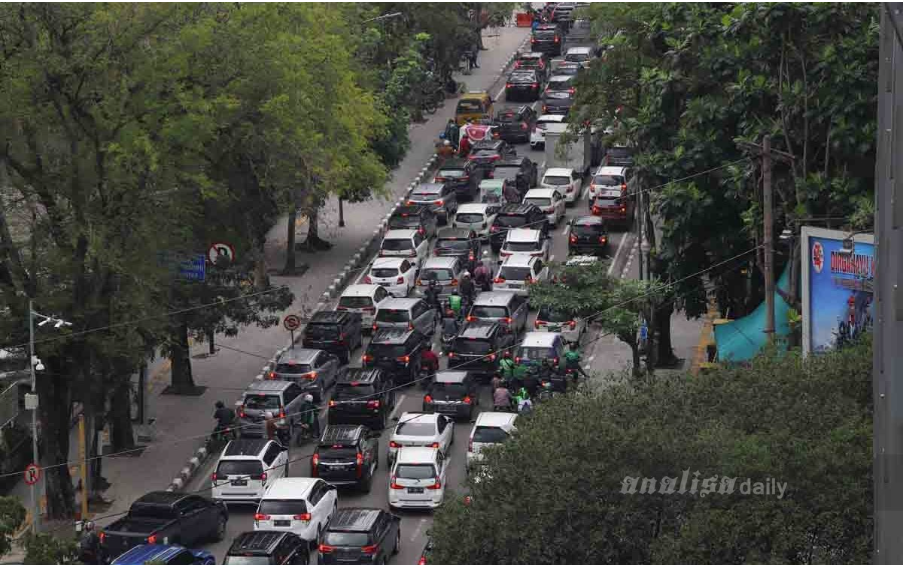
One of the persistent issues in Medan City is traffic congestion. Every day, this problem is evident at various points and intersections, especially during peak hours.
Transportation expert Medis Surbakti attributes the traffic congestion in Medan to the growing number of vehicles, which is not matched by an increase in road capacity. “This causes traffic to pile up, while road infrastructure remains stagnant,” said Medis in Medan on Wednesday (October 14).
Medis, who also serves as the Head of the Civil Engineering Program at Universitas Sumatera Utara, noted that Medan’s road infrastructure has been insufficient, while the number of vehicles continues to rise.
The situation is exacerbated by citizens occupying roadways for other activities. For instance, vendors at various markets use parts of the road for selling, narrowing the road space and often causing traffic jams.
Ironically, Medan’s city government seems to lack the resolve to address this issue decisively. A game of cat and mouse often occurs between government officials, such as Satpol PP, and the public. Enforcement today might result in compliance, but the problem reappears the next day. Until now, a structured and firm solution from the Medan City Government has yet to materialize.
Additionally, Medan’s road network is characterized by short roads and numerous intersections, slowing vehicle movement and causing frequent traffic jams.
As a metropolitan city, Medan cannot develop its infrastructure independently. Strong coordination with neighboring areas, such as Binjai City and Deliserdang Regency, is essential.
This collaboration has led to the introduction of public transportation called Bus Mebidang. However, the program, which has been running for several years, seems to lack public interest. The buses are often empty, and the supporting infrastructure, such as bus stops, is inadequate, making it difficult to attract users.
A comprehensive overhaul of the public transportation system is urgently needed. Currently, public transportation in Medan remains poorly organized. “Moreover, road repairs in Medan are often overlapping,” Medis added.
Coordination among Medan’s city government departments, as well as with provincial, central, and other authorities, is lacking. As a result, many newly repaired roads are quickly damaged again due to excavation for sanitation, gas pipelines, drainage, and other projects. “Smooth roads become damaged again, and this inevitably adds to the congestion,” he explained.
In the future, Medis hopes that Medan will have a leader capable of implementing a pro-urban transportation governance system, especially one who can coordinate effectively with all parties to tackle traffic congestion.
“This way, the APBD budget allocated for road infrastructure repairs will not be wasted. Currently, the public perceives such repairs as temporary. Today it’s fixed; tomorrow it’s damaged again,” he concluded.
The main solution proposed is the regulation and provision of comfortable public transportation for the community, reducing the use of private vehicles. Infrastructure improvements should also be carried out effectively, with strong coordination as the key.
Source: Waspada and Analisa Daily