


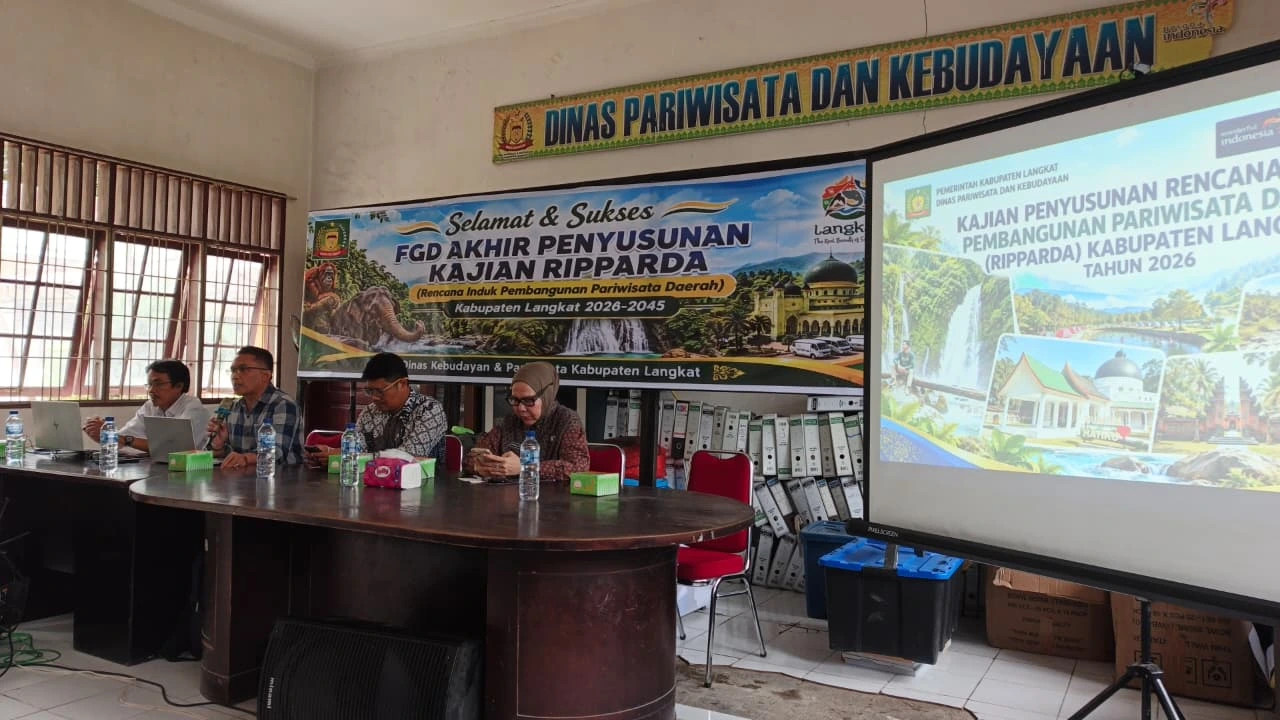
The Undergraduate Program in Urban and Regional Planning (PWK), Faculty of Engineering, Universitas Sumatera Utara (USU), has once again reaffirmed its commitment to supporting regional development based on research and spatial sciences. The Head of the USU Undergraduate Program in PWK and Coordinator of the Governance Research Group at the USU Center of Excellence in Science and Technology (PUI) for Sustainable Tourism, Dr. Anthoni Veery Mardianta, S.T., M.T., IAP, CIIQA, attended as a peer reviewer at the Final Focus Group Discussion (FGD) for the Preparation of the Study on the Regional Tourism Development Master Plan (RIPPARDA) of Langkat Regency for 2026–2045.
The event, organized by the Langkat Regency Office of Culture and Tourism, took place on Thursday, November 12, 2026, at the Hall of the Langkat Regency Office of Culture and Tourism, Stabat. This strategic forum was a continuation of the Initial FGD, which had been held on October 19, 2026, with the main agenda of conducting a comprehensive evaluation and refining the final draft of the study document before it is enacted as a Regional Regulation (Perda) that will guide the direction of tourism development in Langkat Regency over the next two decades.
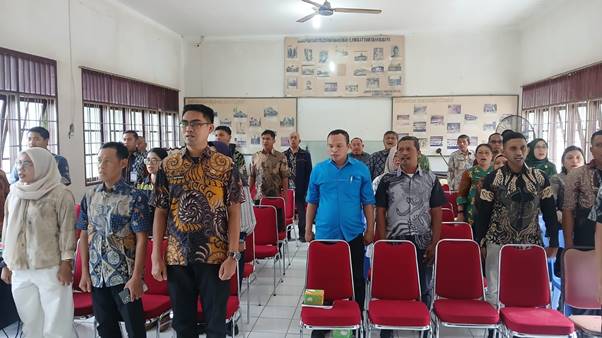
In his presentation entitled "Evaluation and Refinement of the Final Draft of the 2026–2045 Langkat Regency RIPPARDA Study: A Review of Content Compliance Based on Indonesian Minister of Tourism Regulation No. 10 of 2016", Dr. Anthoni Veery Mardianta expressed his appreciation while also providing a constructive critical review of the final draft report prepared by the drafting team. He emphasized that, as a long-term public policy instrument, the RIPPARDA must not only be visionary but also comply with regulatory standards (regulatory compliance), ensure the accuracy of planning methodologies and spatial databases, and be capable of addressing factual issues on the ground.
Appreciation for Regulatory Updates and Primary Data Sources
At the beginning of his review, Dr. Anthoni appreciated the drafting team's progressive efforts to adapt the latest legal framework as the normative basis for the study. The final draft document was noted to have referred to the latest regulations, including Law Number 18 of 2025 concerning the Third Amendment to Law Number 10 of 2009 concerning Tourism, Law Number 32 of 2024 concerning the Conservation of Biological Natural Resources and Their Ecosystems (KSDAE), and Minister of Tourism and Creative Economy Regulation Number 9 of 2021 concerning Guidelines for Sustainable Tourism Destinations. Furthermore, the synchronization of spatial planning dynamics to accommodate the revision process of the Langkat Regency Regional Spatial Plan (RTRW) was also considered an appropriate step. One spatial innovation that received appreciation was the expansion of the region's tourism-driving corridor, which had previously focused on the BULANGTA area (Bukit Lawang–Tangkahan), into the strategic TATABUSEI corridor (Tanjung Pura–Tangkahan–Bukit Lawang–Sei Bingai), as well as the integration of 30 Tourism Villages into the regional tourism zoning system. In addition, the availability of primary data from 2026, covering the mapping of physical profiles, utilities, and management institutions at 39 tourist attractions, along with polygon delineations for 13 tourism areas, provides a strong empirical foundation for formulating policy interventions.
Structuring the Document, Logical Flow, and Data Quality Control
As an academic and certified urban and regional planner, Dr. Anthoni highlighted the importance of ensuring that the document structure complies with the mandate of Minister of Tourism Regulation Number 10 of 2016. He reminded the participants that the mandatory outputs of the Final Report must be structured into 11 chapters divided into two books—namely Book I (Data and Analysis, covering Chapters 1 to 7) and Book II (Plans, covering Chapters 8 to 11)—and must also be accompanied by an Academic Manuscript and a draft Regional Regulation (Raperda). Several mandatory components recommended for immediate completion include the planning methodology in Chapter 1; a study of the position of tourism in the 2025–2045 Langkat Regency Regional Long-Term Development Plan (RPJPD) in Chapter 2; the regional macro profile (basic physical conditions, ecology, demography, socio-culture, and GRDP) in Chapter 3; analysis of the structure of 13 types of tourism businesses and the supply chains of local MSMEs/creative economy in Chapter 5; and the 12th component concerning mechanisms for controlling tourism development.
From a methodological perspective, Dr. Anthoni provided crucial corrections regarding the logical flow of planning (sequential planning). He emphasized that the analysis of the four pillars of tourism and the SWOT analysis must be positioned as the foundation before formulating strategic issues, vision and mission, goals and objectives, and designating Strategic Tourism Areas (KSP), rather than being placed at the end after the designation of areas. In addition, development targets must be specific and measurable, including baseline figures for 2025 and projected targets in five-year stages through 2045 for six key indicators: international tourist visits, domestic tourist movements, tourist expenditure (spending) and length of stay, contribution to Regional Original Revenue (PAD), contribution to GRDP, and employment in the tourism sector.
Regarding the structure of strategies and the indicative program matrix in Chapters 9 and 11, Dr. Anthoni identified that the current program groupings were still based on area nomenclature. Therefore, he recommended restructuring the program matrix into the four mandatory pillars of tourism—Destination Development, Industry, Marketing, and Institutions—with five standard columns containing program titles, indicative activities and specific locations, scheduling across four five-year periods (2026–2030 through 2041–2045), responsible Regional Apparatus Organizations (OPD), and supporting institutions.
Constructive Solutions to Four Factual Tourism Issues in Langkat
The most substantial part of Dr. Anthoni's presentation was the comprehensive mapping of factual tourism issues in Langkat Regency during the 2024–2026 period, directly paired with operational solutions based on RIPPARDA guidelines. Four main clusters of issues were examined in detail:
1. Road Accessibility, Plantation HGU Portal Barriers, and Connectivity Infrastructure
Field surveys in 2026 indicated that the main factors discouraging tourists from visiting Langkat Regency were damaged and uneven connecting roads, as found in Kampung Bali (Wampu Subdistrict), Air Panas Sei Glugur and Batu Rongring (Batang Serangan Subdistrict), Saringgana Waterfall and Simolap Hot Spring (Kutambaru Subdistrict), as well as the road leading to Lubuk Kertang Mangrove Tourism. This issue is exacerbated by the large number of routes to destinations that must pass through plantation concessions under Cultivation Rights (HGU), where access is obstructed by gates, as well as the lack of street lighting and directional signs. These conditions create the threat of competition from destinations in neighboring regions, such as Berastagi, which are more easily accessible.
As a solution, Dr. Anthoni recommended explicitly establishing the Tourism Zoning Structure Plan in Chapter 10 by dividing it into Primary Service Centers (as the regency's gateways and tourist distribution centers) and Secondary Service Centers, aligned with the designation of the Stabat Local Activity Center (PKL), Pangkalan Brandan Local Activity Center (PKL), and Kuala Local Promotive Activity Center (PKLp) in the RTRW. In Chapter 9 (Destination Pillar), a cross-sector coordination strategy needs to be formulated through the establishment of a joint agreement (MoU/PKS) between the Langkat Regency Government, the Public Works and Spatial Planning Office (Dinas PUPR), and plantation companies (PTPN and private companies) to open access to tourism corridors along plantation HGU roads, accompanied by detailed plans for providing supporting transportation infrastructure along the strategic TATABUSEI corridor.
2. Hydrometeorological Disaster Vulnerability, Spatial Conflicts, and Tourist Safety
Water-based tourist destinations downstream of Gunung Leuser National Park (TNGL) face real threats of flash floods, sudden surges in river discharge, and landslides. Flash floods at the end of 2025 even damaged and paralyzed Pantai Buaya Nature Tourism in Besitang Subdistrict. In coastal areas, Kuala Besar Mangrove Tourism has experienced coastal erosion, while Lubuk Kertang Mangrove Tourism has suffered ecosystem damage of up to 60 percent. Meanwhile, inland, the site of the Tomb of King of Langkat Wan Sopan is located in a flood-prone area. In terms of safety, there is a history of Pantai 46 being closed following an incident in which a tourist was swept away, while the trekking route at Lau Berte has yet to meet safety standards. On the other hand, many tourist attractions are located within Protected Areas, Limited/Fixed Production Forests, or River Borders, and are adjacent to Class C mining activities.
In response to these ecological challenges, Dr. Anthoni recommended a strategy of strictly restricting building construction in disaster-prone areas and river borders, as well as constructing gabion seawalls in coastal areas such as Kuala Besar. Zoning plans must be synchronized with physical carrying capacity, the RTRW, Detailed Spatial Plans (RDTR), and Zoning Regulations (Zoning Regulation), accompanied by the regulation of Class C mining activities around nature tourism areas. He also emphasized the importance of synergistic conservation governance with the Gunung Leuser National Park Office, the Environmental Agency (DLH), and the Regional Disaster Management Agency (BPBD), as well as the implementation of standard operating procedures (SOPs) for tourist safety, installation of flood early warning systems (early warning system), and environmental incentive-disincentive schemes.
3. Sanitation and Waste Crises, and Inequality in Amenities
The 2026 survey findings revealed serious sanitation and waste management issues, ranging from damaged waste bins in Bahari Jaring Halus Tourism Village and indiscriminate waste burning practices in Kuala Besar, to the absence of clean water/toilet facilities and wastewater treatment facilities in Batu Malenggang, Saringgana Waterfall, and Lubuk Kertang, as well as poor drainage in front of the Proclamation Monument and the Palace Gate Site in Tanjung Pura City. In addition, accommodation capacity was recorded as stagnant at 968 rooms (across 2 star-rated hotels and 33 non-star-rated hotels/homestays) during 2024–2025, with facilities concentrated only in Bukit Lawang and Tangkahan.
To address these issues, Dr. Anthoni proposed establishing location guidelines and quotas for tourism facilities to encourage a more even distribution of homestays in every Tourism Development Area (KPP) and Strategic Tourism Area (KSP). The urgent infrastructure provision plan in Chapter 10 must include clean water supply, wastewater treatment plants (IPAL) or communal septic tanks, drainage networks, and replication of an integrated waste bank system, such as the one that has been successfully implemented in Bukit Lawang. Under the Industry Pillar, programs are needed for cleanliness, safety, and Muslim-friendly/halal facility certification, as well as intensive training for homestay managers in 30 tourism villages.
4. Short Length of Stay, Neglected Tourist Attractions/Cultural Heritage Sites, and Digital Management Challenges
The lack of variety in attractions has resulted in a very short average length of stay for domestic tourists, at only 1.11 days, as they typically take weekend trips from Medan and Binjai. This contrasts with international tourists, who stay for 3–5 days. A number of tourist attractions have also stagnated or closed, such as Bekancan River, which has been closed since 2022, Air Panas Sei Glugur, Sendang Rejo Agrotourism, and Telaga Asri Naman Jahe, which remains unmanaged despite having received ministry assistance. Meanwhile, the historical potential of the Langkat Sultanate in Tanjung Pura has not been optimally developed, with the surrounding environment of the Regional Museum obstructed by street vendors (PKL). At the site level, local management, business legality, visitor data collection, and review-based digital marketing strategies remain weak.
In response to these conditions, Dr. Anthoni encouraged abandoning the uniform or "one-size-fits-all" recommendation approach—namely, reorganization and promotion for all attractions—and replacing it with the designation of specific flagship tourism product themes and feasibility audits of assets for attractions with failed management. To extend tourists' length of stay, thematic corridors need to be integrated, connecting the revitalization of the Tanjung Pura Old Town Tourism Area (Azizi Mosque, Regional Museum, Old Town Post Office, Proclamation Monument, and Palace Site through the reorganization of street vendors and drainage) and culinary/religious tourism in Stabat City in the downstream area with adventure tourism in the upstream area in one integrated travel package along the TATABUSEI corridor. In terms of marketing, industry, and institutions, he recommended refining market segmentation; developing a Management Supporting System through search engine optimization (SEO) for routes and accommodation; integrating Online Travel Agents (OTA); implementing cashless payments; empowering local MSMEs (culinary products, handicrafts, local coffee, and processed seafood/mangrove products such as shrimp paste and salted fish in Kuala Besar and Jaring Halus); and strengthening the capacity of Tourism Awareness Groups (Pokdarwis) and Village-Owned Enterprises (BUMDes) by replicating the successful self-managed governance model of the Tangkahan Tourism Institution (LPT).
The ideas contributed by Dr. Anthoni Veery Mardianta at this Final FGD forum received a warm welcome from the Langkat Regency Government officials and the drafting team. The involvement of USU PWK academics in overseeing this regional planning document is expected to help ensure that the 2026–2045 Langkat Regency RIPPARDA Regional Regulation is not only academically and legally robust but also applicable, spatially equitable, disaster-resilient, and capable of elevating tourism in Langkat Regency to a higher level nationally and internationally.