


In general, a fire occurs when the three main elements of the “fire triangle” come together: fuel, heat, and oxygen. In the fire tetrahedron theory, a fourth element is added—the chemical chain reaction.
An ignition source is a condition or energy source that causes a combustible material to reach its ignition temperature or condition. An ignition source is, of course, different from fuel. Fuel provides the material that burns, while the ignition source supplies the initial energy needed to start the combustion process.
Extinguishing a fire means interrupting one or more of these elements through cooling, smothering (reducing oxygen), removing the fuel, or breaking the chemical chain reaction.
Conventional Dry Chemical Powder (DCP), particularly the ABC type based on monoammonium phosphate (MAP), works primarily by interrupting the chemical chain reaction and coating the fuel. However, DCP has several drawbacks: it leaves a dirty residue, is slightly corrosive, and is not environmentally friendly. For this reason, the idea has emerged of utilizing local and biodegradable materials such as cassava flour (also known as tapioca flour, derived from the tuber of Manihot esculenta).
This article attempts to discuss the subject scientifically—examining the potential, mechanisms, research evidence, limitations, and prospects of cassava flour as an extinguishing medium—based on fire science principles and available research data.
Edi Yasa Ardiansyah, a lecturer in the Mining Engineering Study Program, Faculty of Engineering, Universitas Sumatera Utara (USU), has prepared a scientific review of the possible use of cassava flour in fire-suppression technology.
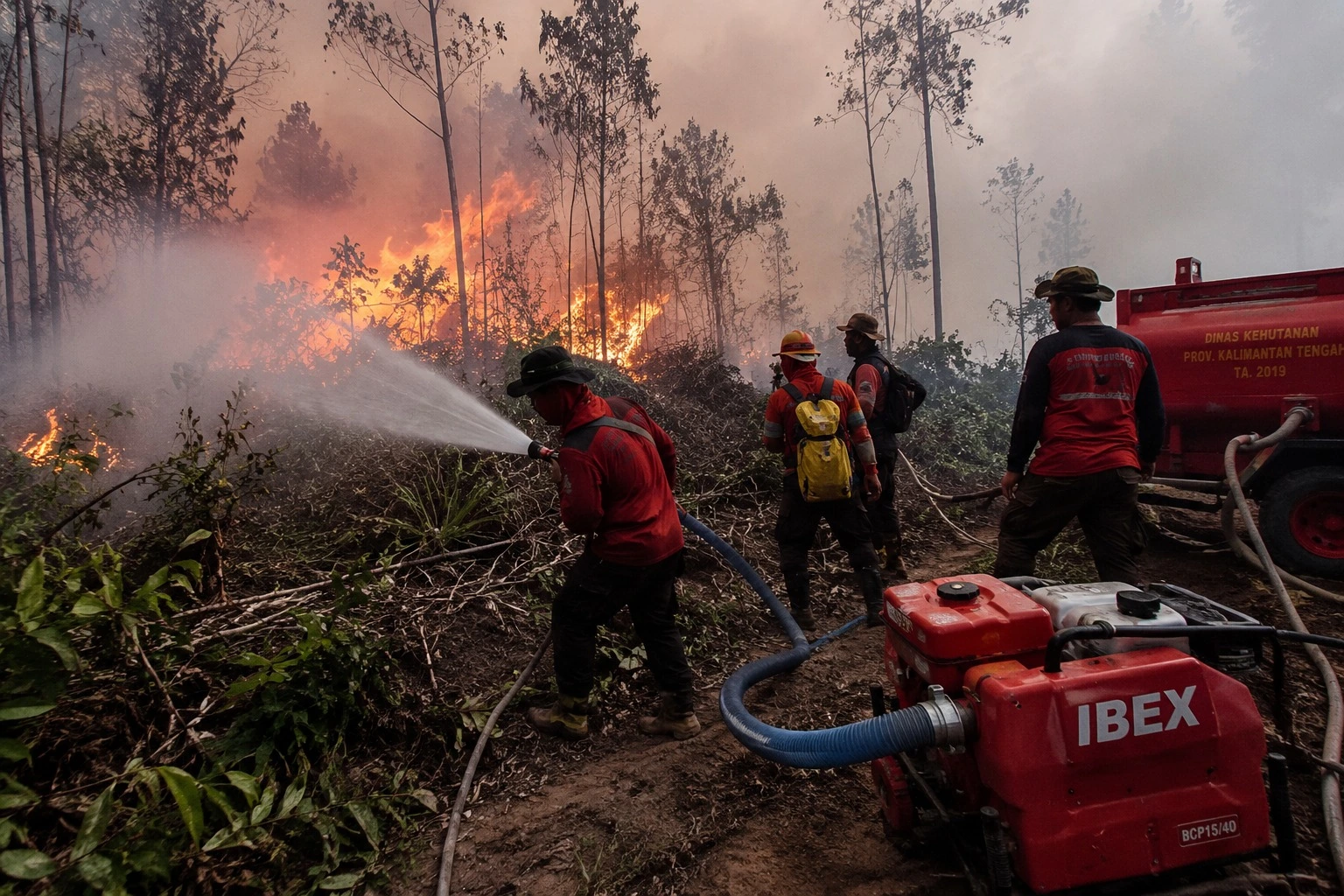
The study explains that cassava flour is not a direct substitute for Dry Chemical Powder. However, as an inexpensive, abundant material in Indonesia that is also biodegradable, cassava starch (especially from peel waste) has scientific potential to be developed into an alternative or complementary extinguishing medium through appropriate formulation—for example, by mixing it with retardants, processing it into a gel, or using it as a char-forming matrix. Further development will certainly require systematic research (fire performance testing, toxicity assessment, and stability evaluation), collaboration among researchers, industry, and standardization bodies (such as BSN and BRIN), as well as controlled field trials, particularly for small- to medium-scale forest and land fire applications.
Through a careful scientific approach, innovation based on cassava flour can become a local contribution that supports fire-suppression principles while reducing dependence on synthetic chemicals. To date, the best available evidence shows that success depends on modification and combination, not on pure cassava flour alone. This, of course, presents both a challenge and an opportunity for us to provide solutions.
This science-based communication activity most strongly supports SDG 4 on Quality Education because it helps the public understand the opportunities and risks of innovation critically. The potential development of local materials is related to SDG 9, while the orientation toward fire management and reduced reliance on synthetic materials has relevance to SDG 13.
The Faculty of Engineering at USU emphasizes the importance of scientific caution in assessing safety innovations. Collaboration among researchers, industry, and standardization institutions is necessary so that the development of cassava-based materials proceeds safely, measurably, and does not outpace the available evidence.