


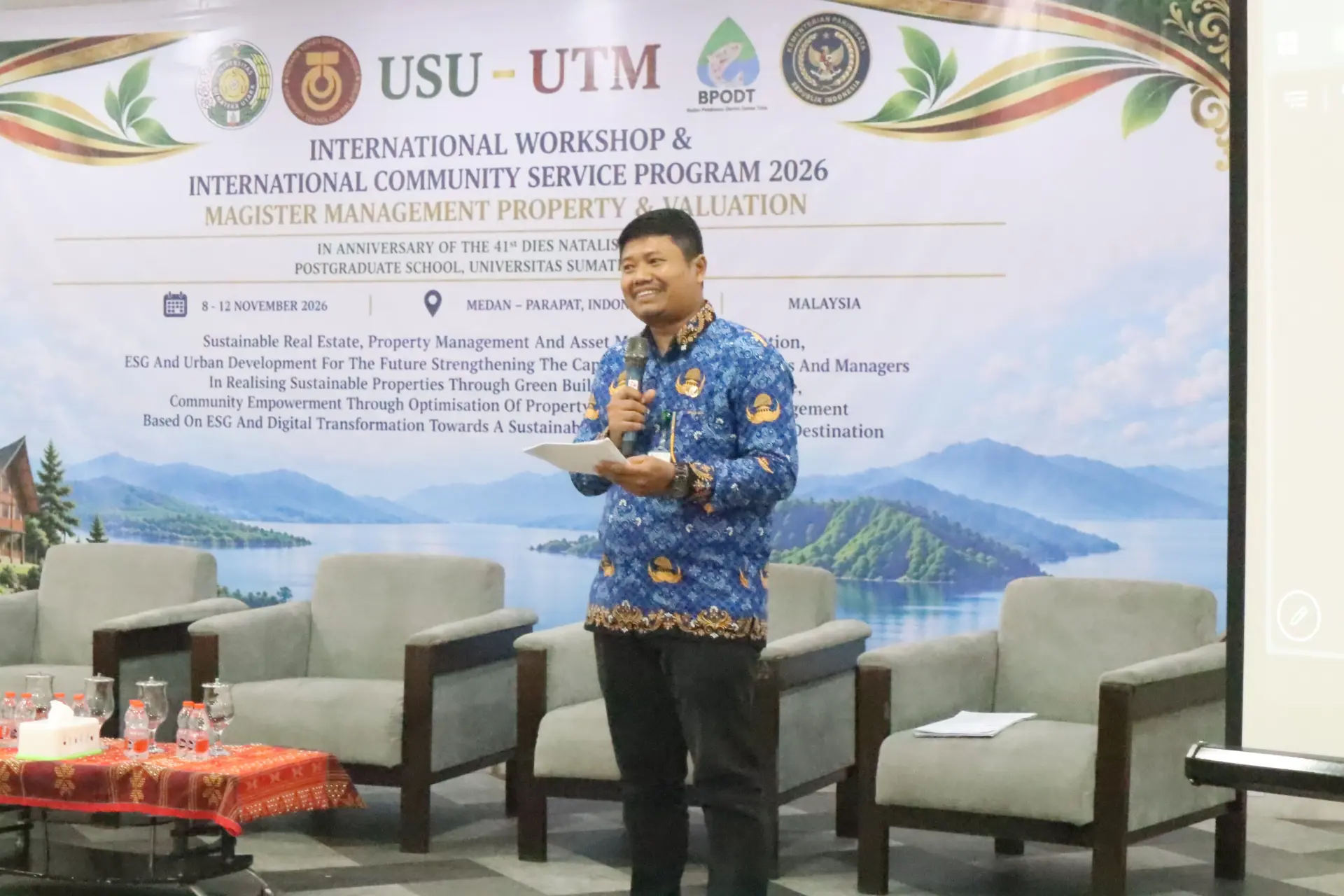
MEDAN (November 10, 2026) – USU Urban and Regional Planning continues to strengthen its academic contributions and international interdisciplinary collaboration networks. Dr. Anthoni Veery Mardianta, S.T., M.T., IAP, CIIQA, a lecturer in USU Urban and Regional Planning, attended and actively served as moderator at a prestigious scientific event entitled International Workshop and International Community Service Program, organized by the Master's Program in Property Management and Valuation (MMPP), USU Postgraduate School.
In the contemporary development landscape, future urban development can no longer be viewed separately from public spatial planning regulations and private property market mechanisms. In his role as moderator, Dr. Anthoni Veery Mardianta guided the discussions at this international workshop to examine the intersection of spatial planning policies, asset valuation, and ecological and social sustainability requirements.
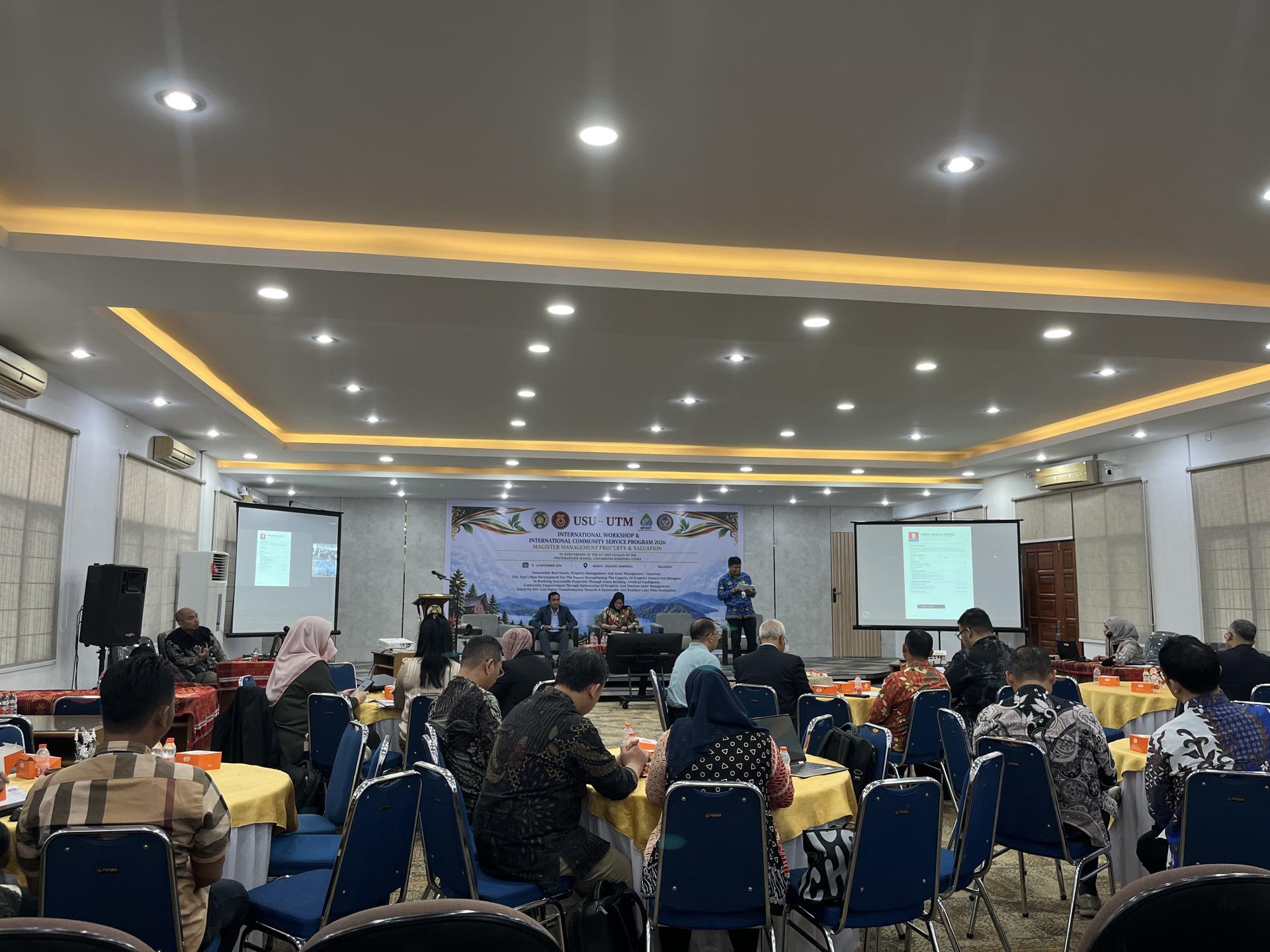
In-Depth Exploration of Sustainable Real Estate and the Integration of ESG Principles
One of the key focuses explored in depth during the International Workshop and International Community Service Program was the transition toward Sustainable Real Estate and the implementation of the Environmental, Social, and Governance (ESG) framework in the property industry and asset valuation. At the global level, ESG parameters have shifted from being merely voluntary compliance instruments to becoming key indicators in determining economic value, investment feasibility, and the sustainability of urban development projects.
During the discussion session moderated by Dr. Anthoni, three key dimensions of ESG integration into urban planning and asset management were identified as the central themes of the discussion:
1. The Environmental Dimension in Urban Design and Valuation Sustainable real estate development requires the implementation of green building principles, energy efficiency, integrated water and waste management, and efforts to decarbonize urban areas. From a valuation perspective, property assets that adopt environmentally friendly certifications and demonstrate resilience to climate risks have been shown to possess greater value resilience in the future compared to conventional properties that are vulnerable to depreciation due to ecological risks.
2. The Social Dimension and Inclusivity of Urban Spaces: Property development and the management of both public and private assets must generate measurable social impacts for surrounding communities. In the context of future urban development, this includes providing inclusive public open spaces, ensuring accessibility for all community groups, preventing gentrification that marginalizes local residents, and creating built environments that support the health and well-being of their occupants.
3. The Governance Dimension and Transparency in Asset Management Accountability in land governance, compliance with Regional Spatial Plans (RTRW) and Detailed Spatial Plans (RDTR), and transparency in the management of regional and corporate assets are fundamental foundations. Good governance ensures that the utilization of land and building assets generates optimal added value for regional economic growth while maintaining spatial justice.
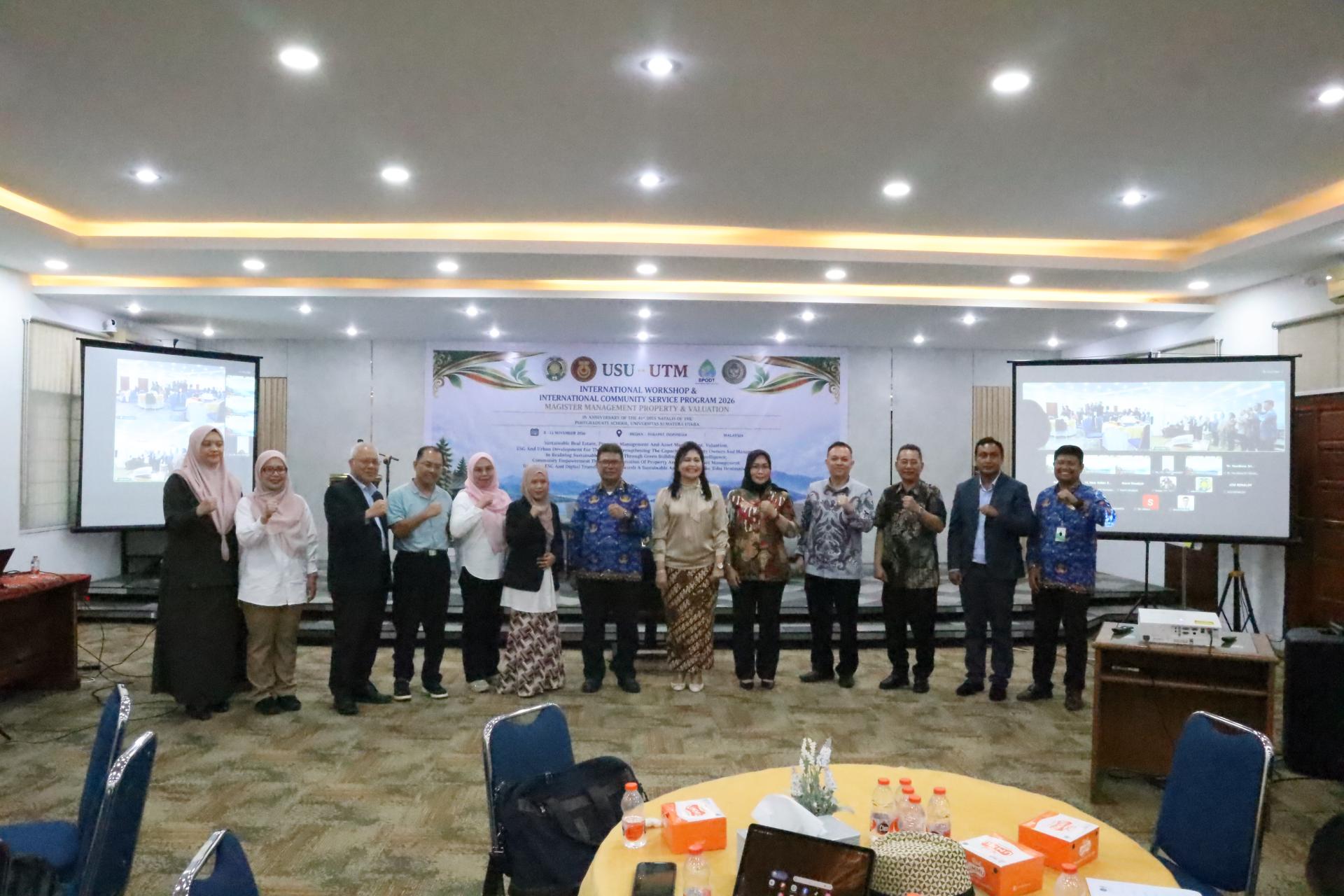
In addition to sustainability issues, the international forum at USU Postgraduate School also examined strategic challenges in Property and Asset Management and updates to Valuation methodologies in the era of digital transformation. The management of urban assets—whether owned by local governments, business entities, or public institutions—requires an asset lifecycle management approach based on precise spatial data and analytics.
While moderating the discussion, Dr. Anthoni Veery Mardianta also emphasized how the use of geospatial technology and urban modeling can work in synergy with property valuation. The integration of Geographic Information Systems (GIS) and spatial databases enables appraisers and urban planners to analyze land value capture dynamics, map regional economic potential, and formulate innovative and sustainable urban infrastructure financing schemes. Thus, asset management no longer functions merely as an administrative activity for recording assets but is transformed into a strategic instrument for driving regional development.
Through active participation in international scientific forums of this kind, the USU Undergraduate Program in Urban and Regional Planning continues to demonstrate its commitment to providing academic contributions relevant to contemporary needs. It is hoped that a broader understanding of sustainable real estate, ESG principles, asset governance, and future urban development visions will not only enrich the academic environment but also strengthen Universitas Sumatera Utara's position as a center of academic excellence in shaping the future of livable, competitive, and sustainable cities.