


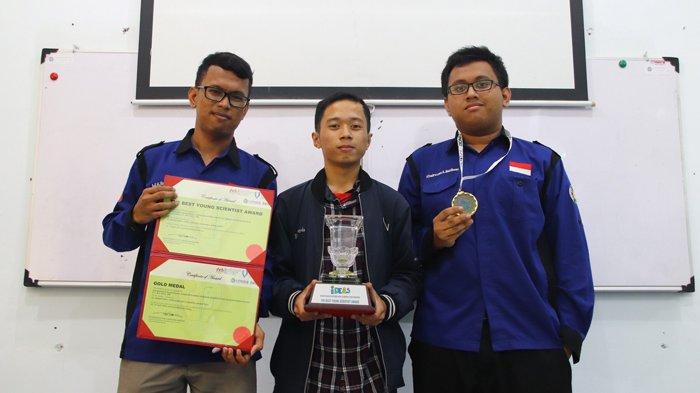
Once again, we have reason to be proud. Chemical Engineering students have won awards at the International Festival of Innovation on Green Technology (IFINOG). The team consists of Adi Herianto Rajagukguk, Khairuzan Ahmad Hasibuan, and Habibie Satrio Nugroho, collectively known as the Gantari Team.
During the event held from April 19-21, 2019, organized by Universiti Malaysia Pahang, the Gantari Team achieved two awards: The Best Young Scientist Award and a gold medal.
"There was the International Festival of Innovation on Green Technology 2019 (IFINOG) competition, which was divided into two categories: Festival and Ideas. We participated in the Ideas category," explained Adi.
The idea for creating the biobattery was inspired by the abundance of unused corn cob and seashell waste. "Biobatteries are similar to commercial batteries, but their electrolytes are replaced with organic components. We replaced the carbon with corn cobs, while calcium carbonate was obtained by extracting seashells," said Adi Herianto Rajagukguk, the leader of the Gantari Team.
The university provided full support for the students' achievements. This included providing facilities to ensure the best results and encouraging students who successfully conducted research to patent their products soon. This was revealed by Maya Sarah, S.T., M.T., Ph.D., IPM, who served as the Gantari Team's advisor.
"There are various forms of appreciation, such as providing facilities to achieve the best research results," explained Mrs. Maya Sarah.
This news can also be accessed [here].