


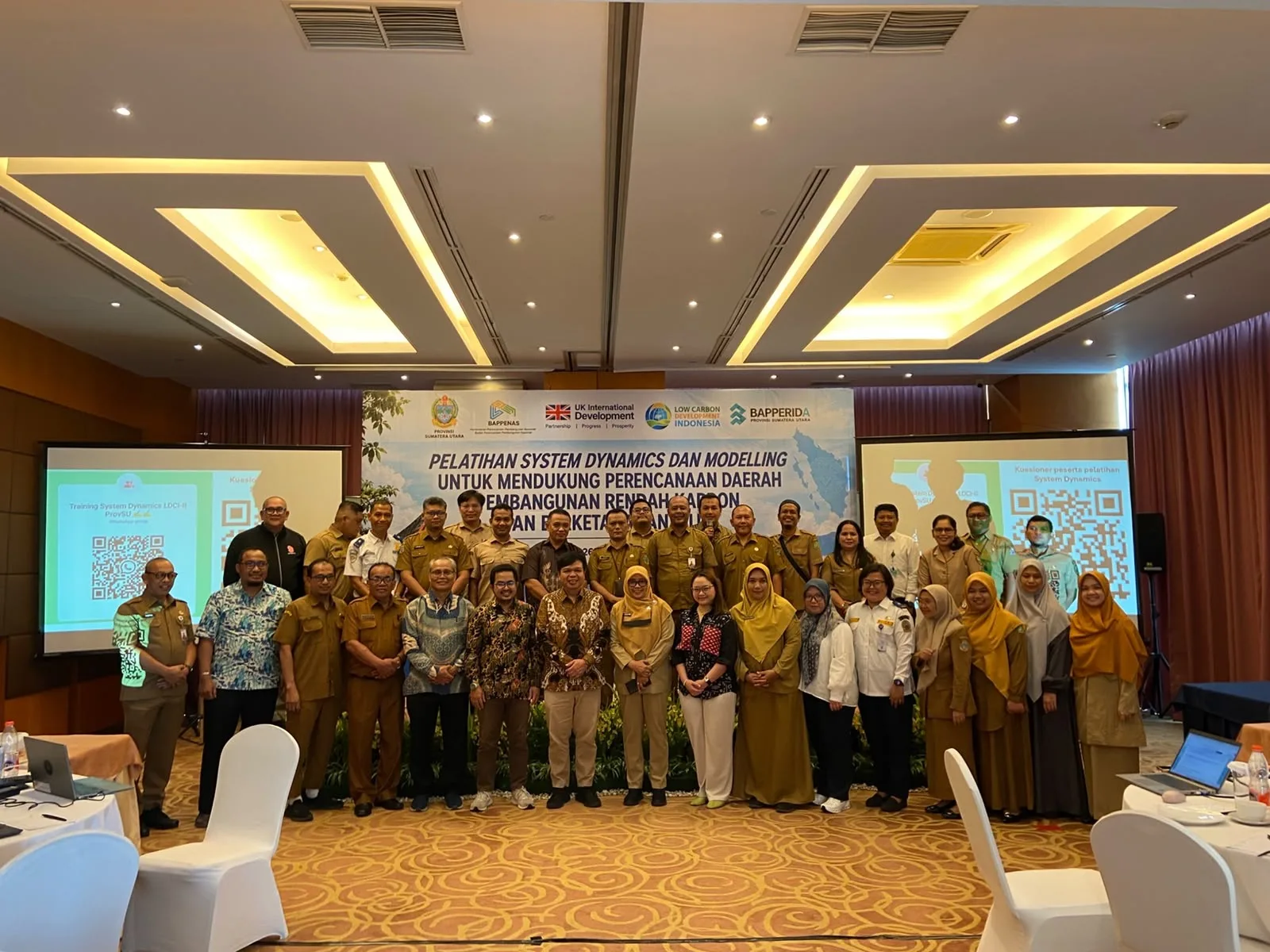
Medan – Delegates from Universitas Sumatera Utara (USU) representing the Institute for Research and Community Service (LPPM USU), including Dr. Anthoni Veery Mardianta, S.T., M.T. (Urban and Regional Planning Program) and Novrida Harpah Hasibuan, S.Si., M.T. (Environmental Engineering Program), actively participated in the "System Dynamics Training to Support the Implementation of Low Carbon and Climate Resilient Development (PRKBI) in North Sumatra Province."
The four-day workshop, held from October 26–29, 2026, at Cambridge Hotel Medan, was organized by the Regional Planning, Research, and Innovation Agency (Bapperida) of North Sumatra Province in partnership with PT Hatfield Indonesia, appointed by the Low Carbon Development Initiative (LCDI-2) Oxford Policy Management Limited (OPML).
The training gathered 33 selected participants, including regional planners from Provincial Government Agencies (OPD), representatives from Bapperida and Environmental Services across the Mebidangro metropolitan region (Medan, Binjai, Deli Serdang, and Langkat), alongside LPPM USU academics.
The initiative addresses the urgent need to integrate green economy policies and climate adaptation into regional planning documents—such as the RPJMD, Renstra, RKPD, and the North Sumatra PRKBI Plan 2025–2045—to support national greenhouse gas reduction targets toward Indonesia Emas 2045. To navigate complex, cross-sectoral development challenges, participants were trained in holistic systems thinking and quantitative dynamic modeling using Powersim Studio and Stella software to simulate waste management policy scenarios, land cover changes, and regional emissions.
Mastery of system dynamics equips USU academics with a strategic tool to assist local governments in formulating evidence-based spatial and regional development policies through model validation, scenario evaluation, and risk analysis. Furthermore, these dynamic modeling techniques will be integrated directly into lecture curricula and planning studio courses within the Urban and Regional Planning program, enhancing students' spatial-policy analytical skills for future climate challenges.
This strategic capacity-building initiative directly supports Sustainable Development Goals SDG 4 (Quality Education) by enriching academic curricula with advanced modeling methodologies, SDG 13 (Climate Action) by advancing regional low-carbon and climate-resilient policy frameworks, and SDG 17 (Partnerships for the Goals) through multi-stakeholder collaboration among higher education institutions, provincial government bodies, and international development agencies.