


.webp)
The Faculty of Engineering at USU implemented a community service program to strengthen disaster preparedness in the Pantai Citra Tourism Area, Namo Sialang Village, Batang Serangan District, Langkat Regency. Funded through the 2026 TALENTA Pioneer Community Service Scheme, the program brought together the expertise of the Environmental Engineering and Architecture Study Programs of FT USU to apply scientific knowledge to community needs.
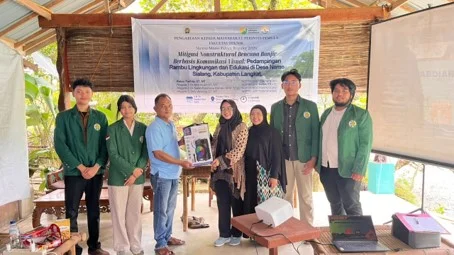
The tourism area, which utilizes the flow of the Batang Serangan River, faces the risk of flash floods originating from upstream areas. In response to this situation, the FT USU team implemented a non-structural mitigation approach based on visual communication to help the community and tourism managers understand the risks, evacuation routes, and emergency response procedures.
The program was led by Fadhila, S.T., M.T., a lecturer in Environmental Engineering at FT USU, together with Dr. Amir Husin, S.T., M.T.; Dr. Sarah Patumona Manalu, SKM., M.Sc.; and Ar. Selly Veronica, S.T., M.T., IAI, from the Architecture Study Program at USU. Four FT USU students were also involved in field learning, risk surveys, and community outreach on disaster mitigation.
The activities included participatory education and disaster simulations for Pantai Citra tourism managers, Namo Sialang Village officials, the Youth Organization (Karang Taruna), and elementary school students. The materials focused on recognizing natural warning signs, understanding evacuation routes, and identifying the actions to take when flood threats arise.
The team provided risk communication tools, including visual safety signs, emergency communication equipment, and emergency response SOPs that can be used by tourism managers and the village government. These tools and educational activities represent an initial step toward strengthening community preparedness. Their long-term effectiveness, however, will require continuous implementation, maintenance, and evaluation.
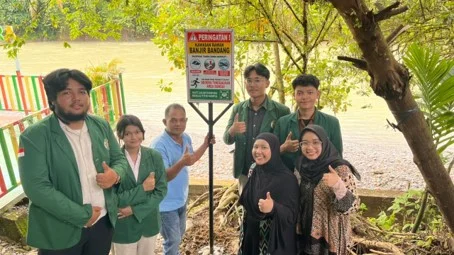
This activity supports SDG 11 – Sustainable Cities and Communities through efforts to build more disaster-resilient tourism areas and riverside communities. Its contributions to SDG 4 – Quality Education and SDG 13 – Climate Action are reflected in disaster education and efforts to strengthen adaptive capacity in response to hydrometeorological risks.
FT USU encourages sustained interdisciplinary collaboration so that academic knowledge can continue to be applied in ways that are relevant to community needs.