


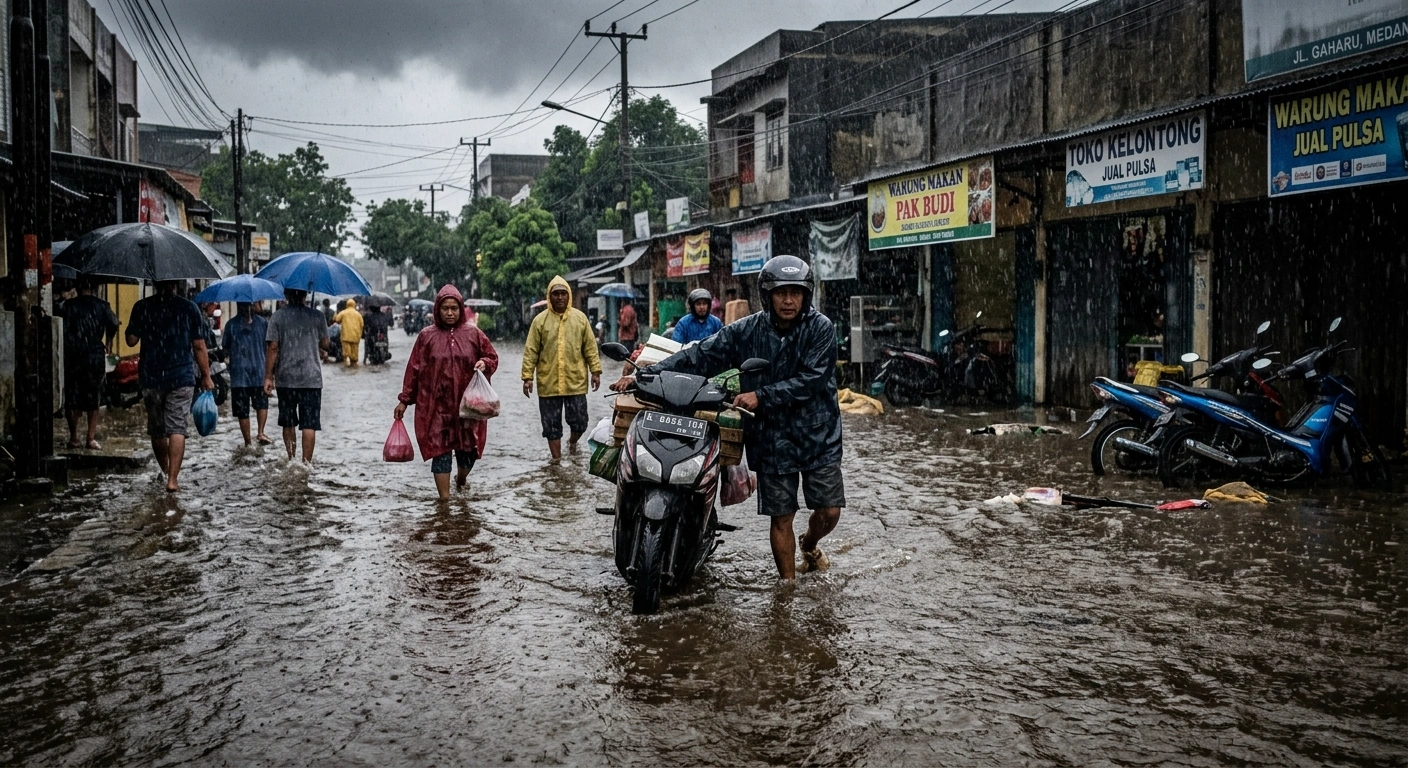
MEDAN, September, 20 2026 | Weather conditions across several areas of North Sumatra are expected to remain variable through the end of September 2026. According to forecasts issued by the Meteorology, Climatology, and Geophysical Agency (BMKG), communities should remain alert to light rain, thunderstorms, lightning, strong winds, and periods of drier conditions.
In its forecast for 18 to 24 September 2026, BMKG identified North Sumatra as one of the areas requiring increased vigilance for heightened rainfall. From 18 to 20 September, several areas may experience heavy to very heavy rainfall accompanied by lightning and strong winds. The potential for increased rainfall should also be monitored from 21 to 24 September.
These conditions indicate that weather patterns across North Sumatra remain dynamic. Although the influence of El Niño continues to support relatively dry atmospheric conditions in some areas, local and regional atmospheric dynamics may still trigger locally intense rainfall.
Weather Conditions Vary Across Regions
BMKG forecasts indicate considerable variation in weather conditions across North Sumatra.
In Medan and Deli Serdang, light rain is expected from 20 to 22 September, followed by hazy or smoky conditions on 23 September and a potential for lightning on 24 September. Further periods of light rain may occur on 25 September and from 28 to 29 September.
Binjai is expected to experience light rain from 20 to 22 September, thunderstorms on 23 September, and lightning on 24 September. Meanwhile, Karo is expected to record relatively cooler temperatures, ranging from approximately 19°C to 27°C, with the potential for rain and lightning on several days.
In Simalungun and Pematangsiantar, light rain is expected from 20 to 23 September, followed by lightning on 24 September. Thunderstorms may return on 27 September.
Eastern coastal areas, including Serdang Bedagai, Batu Bara, and Tanjung Balai, are also expected to experience varying weather conditions, ranging from light rain to potential lightning. In Samosir and the Lake Toba area, temperatures may range from approximately 17°C to 25°C, with opportunities for rain and lightning on several days.
On the western coast, Central Tapanuli and Sibolga should also remain alert to the potential for lightning. Meanwhile, southern areas such as Padangsidimpuan and Mandailing Natal, as well as the Nias Islands and Gunungsitoli, may experience changing weather conditions and lightning.
These variations indicate that provincial-level weather information alone may not be sufficient for planning daily activities. Local forecasts and early warnings should be monitored before undertaking outdoor activities.
Hydrometeorological Disaster Risks
Rain and lightning do not necessarily mean that disasters will occur. However, such conditions can increase risks when combined with environmental and infrastructure vulnerabilities.
High-intensity rainfall over a short period may cause waterlogging and flooding, particularly in urban areas with extensive impermeable surfaces and limited drainage capacity.
In hilly and mountainous areas, rainfall can increase soil saturation and consequently contribute to landslide risks, particularly on steep slopes, areas experiencing land-cover changes, or locations where ground cracks have already appeared.
The potential for lightning and strong winds also requires attention. People engaged in outdoor activities should seek shelter when thunder is heard and avoid taking shelter under trees.
At the same time, relatively dry atmospheric conditions continue to raise concerns about drought and forest and land fires. Communities are therefore advised to avoid burning waste or using fire to clear land.
Higher Education Institutions Have a Strategic Role
These conditions demonstrate that disaster risk management is not solely the responsibility of government authorities and communities. Higher education institutions have an important role in generating knowledge, technology, and practical solutions that can be applied in the field.
The USU Faculty of Engineering (FT USU) has several academic disciplines that are directly relevant to these challenges.
Environmental Engineering can contribute through research on drainage systems, rainwater management, water quality, pollution control, and post-flood environmental management.
Civil Engineering and Urban and Regional Planning can contribute to the planning and assessment of infrastructure, including spatial conditions, drainage systems, roads, bridges, and buildings designed to better withstand extreme weather.
Mining Engineering and geotechnical disciplines can support slope stability assessments, soil and rock characterization, and the mapping of areas vulnerable to landslides.
Meanwhile, Electrical Engineering and digital technology can support the development of sensor-based monitoring systems, the Internet of Things (IoT), and early warning systems capable of detecting changes in rainfall, water levels, soil moisture, and environmental conditions in a timely manner.
Such interdisciplinary approaches can transform weather and disaster-related challenges into opportunities for education and research while generating practical benefits for communities.
Aligned with Kampus Berdampak and the SDGs
This role is consistent with the Kampus Berdampak initiative, which encourages higher education institutions to ensure that education, research, and community engagement address real-world challenges.
FT USU has also aligned various academic and community engagement activities with the Sustainable Development Goals (SDGs). Weather and disaster-related issues are closely connected to several SDGs.
SDG 6 addresses clean water and sanitation. SDG 9 focuses on industry, innovation, and infrastructure. SDG 11 promotes sustainable cities and communities. SDG 13 addresses climate action. Meanwhile, SDG 15 focuses on the protection of terrestrial ecosystems.
Research on flooding, landslides, early warning systems, climate-resilient infrastructure, environmental quality, and climate change is therefore not merely an academic undertaking. It represents a contribution by higher education institutions to sustainable development.
Turning Weather Data into Solutions
BMKG data can serve as a starting point for higher education institutions to develop broader knowledge systems.
Rainfall data can be integrated with topographic data, land-use information, drainage capacity, soil conditions, and disaster records. These datasets can then support the development of risk maps, predictive models, early warning systems, and technical recommendations for government authorities and communities.
This approach demonstrates that weather information extends beyond the simple question of whether it will rain or remain hot. Weather data can provide a foundation for designing more resilient infrastructure, reducing disaster risks, protecting the environment, and strengthening community resilience.
Communities Must Remain Vigilant
Communities across North Sumatra are advised to check BMKG forecasts and early warnings before undertaking outdoor activities. Drainage channels should be kept clear, while residents living in sloped areas should monitor ground cracks and changes in water flow.
During thunderstorms, people should seek shelter inside safe buildings and avoid standing under trees. Motorists should also reduce their speed during heavy rain, as visibility and road conditions can change rapidly.
During drier periods, communities should conserve water and avoid burning waste or land.
Weather conditions in North Sumatra during September 2026 demonstrate that dry conditions and intense rainfall can occur within the same period. Preparedness therefore needs to be dynamic and information-based.
For higher education institutions, these conditions provide an opportunity to strengthen research, innovation, disaster education, and community engagement. For FT USU, they also provide a practical avenue to advance the principles of Kampus Berdampak and the SDGs by connecting scientific knowledge, technology, and the needs of communities across North Sumatra.
Note: Weather forecasts may change as atmospheric conditions develop. Communities are advised to follow official BMKG updates, including daily forecasts, early warnings, and nowcasting information.