


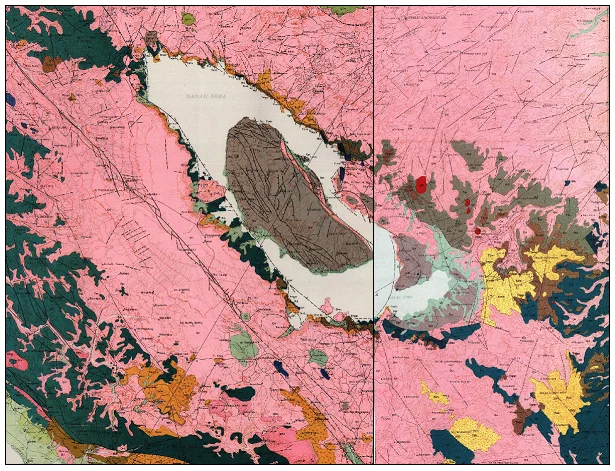
TOBA, NORTH SUMATRA | The phenomenon of ground tremors accompanied by a rumbling sound resembling an engine roar—felt by residents in several parts of Toba Regency over approximately the past three months—requires deeper geophysical investigation. Geologists assess that North Sumatra's tectonic conditions, the presence of the Renun Segment, and the complexity of subsurface structures in the Lake Toba area must be part of a study to uncover the source of the phenomenon.
The tremors were reported to have been felt by residents of Partoruan Lumban Lobu Village, Bonatua Lunasi District—particularly in Dusun 3 Lumban Gambiri and Lumban Dolok—as well as Silamosik I Village, Porsea District. Initial information from BMKG Region I Medan noted weak tremors with a frequency of around 5 Hz.
Two geology experts from the Faculty of Engineering at Universitas Sumatera Utara (USU), Gustam Lubis and Edi Yasa, assess that the phenomenon needs to be examined based on geophysical data and regional geological conditions. Both emphasize that the source of the tremors cannot yet be confirmed, so research must be conducted to distinguish between potential tectonic causes, subsurface structural conditions, and other geological mechanisms.
The Renun Segment is one of the geological structures that needs to be studied
Gustam Lubis explained that the Toba area has a complex tectonic structure. One of the major faults adjacent to the area is the Renun Segment, alongside the Sumatran Fault System (SFS).
According to Gustam, the ground tremors and rumbling sounds around Porsea require an investigation of subsurface conditions using geophysical instrumentation. Such a study is needed to determine rock characteristics and geological structures that may be related to the phenomenon experienced by the community.
"The major faults adjacent to Toba itself are the Renun Segment, alongside the Great Sumatran Fault (SFS). Given the ground tremors and rumbling sounds near Porsea, we need to investigate the subsurface conditions in that area using geophysical instrumentation, particularly looking for differences in rock density. Those differences will be recorded in seismic waves so that subsurface conditions can be mapped," Gustam explained.
He added that observations and instrument installations are ideally carried out in fault zones, paying attention to the positions of the hanging wall and footwall. Observations on both sides of the structure can help identify differences in geological characteristics and subsurface geophysical responses.
This approach is considered important because variations in density, rock types, fractures, and geological structures can influence geophysical response characteristics. Measurements conducted simultaneously at several locations are expected to provide a clearer picture of subsurface conditions in the area experiencing the tremors.
Sumatra's tectonic dynamics serve as an important context
Meanwhile, Edi Yasa explained that the tremor phenomenon needs to be viewed within the context of North Sumatra's tectonic dynamics. The Sumatra region lies within an active tectonic setting influenced by the interaction between the Indo-Australian Plate and the Eurasian or Sunda Plate, as well as the presence of the Sumatran Fault System.
Subduction activity west of Sumatra, including areas around the Nias Islands, is marked by relatively intense seismicity. These plate movement processes are part of ongoing regional geological dynamics.
Based on initial BMKG information and the area's geological conditions, Edi assesses that the tremors around Toba Regency still have a possible link to regional tectonic activity. However, a direct relationship between that tectonic activity and the tremors felt by residents cannot yet be confirmed without further data analysis.
According to him, identifying the source of the tremors requires analyzing seismic signal characteristics, source location, temporal patterns of occurrence, and the relationship between regional seismicity and local tremors.
While the presence of active faults and subduction activity can serve as a basis for formulating scientific hypotheses, it is not yet sufficient to establish the cause of the phenomenon occurring around Porsea and Bonatua Lunasi.
Possible links to Lake Toba's magmatic system are still being studied
The tremor phenomenon has also raised questions about its possible connection to the magmatic system beneath Lake Toba. The Toba area is a volcanic caldera with a complex geological history, making its subsurface structure an important object of geological and geophysical research.
Edi Yasa affirmed that the possibility of tectonic dynamics influencing the magmatic system beneath Lake Toba still requires further study. Interactions among tectonic processes, fault structures, crustal stress changes, and subsurface fluid systems can theoretically be examined in geological research, but cannot yet be directly linked to the ongoing tremor phenomenon.
Tremors with a frequency of around 5 Hz also cannot be used as a direct indicator of magma activity. Determining whether there is a connection to the volcanic system requires additional data in the form of seismic monitoring, surface deformation, geological conditions, and relevant geophysical and geochemical parameters.
Both experts assess that further research is essential before drawing conclusions about the source of the tremors or a possible link to Lake Toba's magmatic system.
Geophysical research is needed to uncover the source of the tremors
To uncover the source of the phenomenon, subsurface investigations need to be carried out using an integrated geophysical approach. Installing seismic sensors at several points around the affected area can help record tremor characteristics, amplitude, frequency, and wave propagation patterns.
Gravity surveys can be used to identify variations in subsurface rock density, while geoelectrical or resistivity methods can help evaluate rock characteristics, fractures, and possible fluid distribution. The results of measurements from these various methods can be combined to build a more comprehensive model of subsurface conditions.
Observations also need to account for identified fault structures, including the Renun Segment, and compare geophysical responses across different locations. With this approach, researchers can test whether the tremor phenomenon is related to specific geological structures or has another source.
Beyond geological possibilities, non-geological vibration sources also need to be examined so the investigation does not focus on a single hypothesis. Machinery activity, infrastructure, anthropogenic vibration sources, or sound and acoustic wave propagation mechanisms may serve as alternatives that should be tested against evidence.
Inter-institutional collaboration is important to ensure research outcomes
A phenomenon recurring over several months and felt by the community requires continuous monitoring. Collaboration among BMKG, the Geological Agency (Badan Geologi), universities, local governments, and research institutions is considered important to strengthen data collection and scientific analysis.
Coordinated monitoring can help identify the source of the tremors, understand the geological conditions of the affected area, and provide more accurate information to the public.
Both experts emphasize the importance of follow-up research to investigate the phenomenon objectively. Regional tectonic activity, the presence of the Renun Segment, subsurface structures, and potential interactions with Lake Toba's volcanic system are aspects that must be studied scientifically, without first establishing unproven causes.