


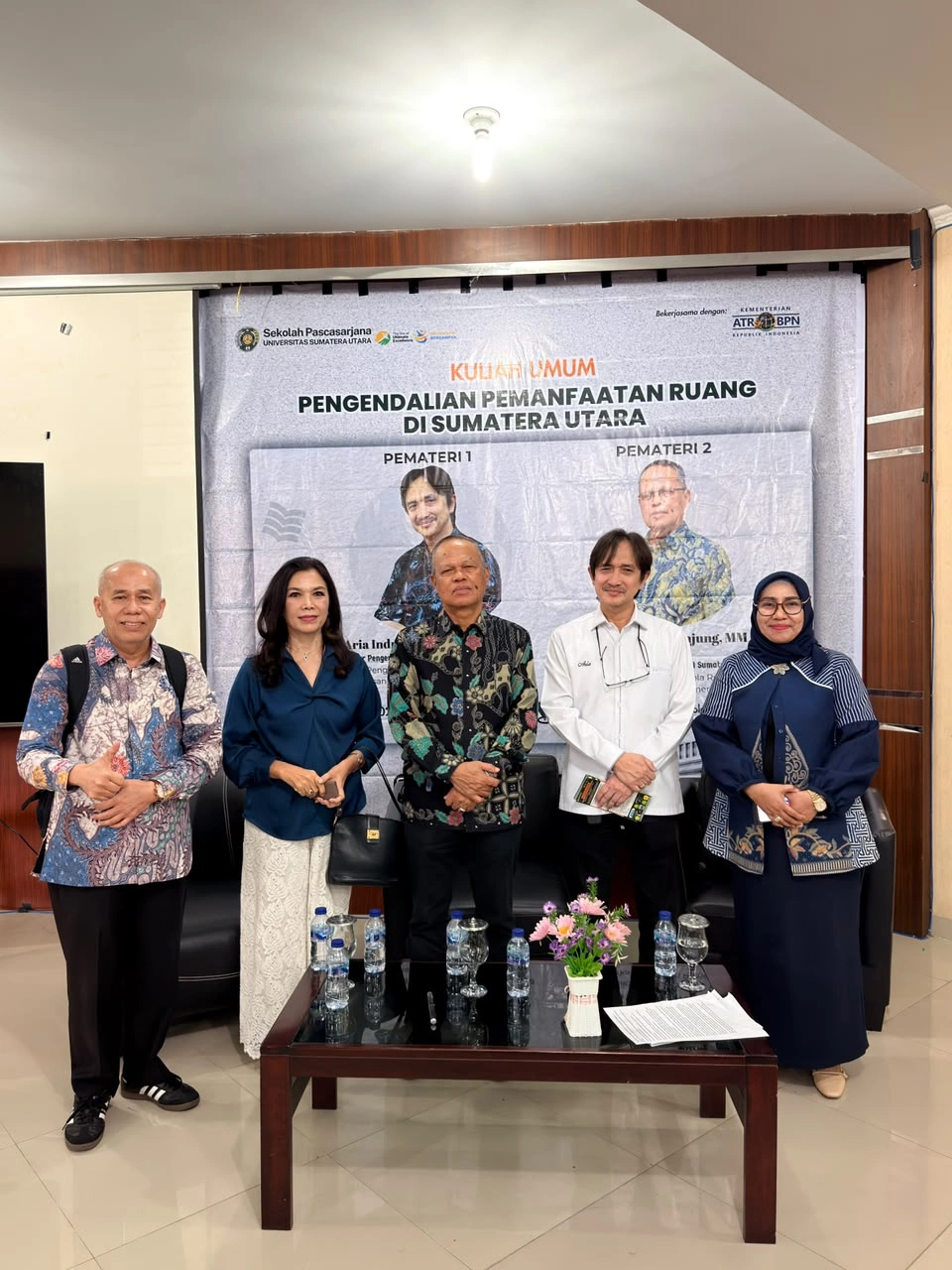
MEDAN, September 20, 2026 | The Doctoral Program in Regional Planning (S3) and the Master’s Program in Regional and Rural Development Planning (S2) at the Graduate School of Universitas Sumatera Utara (USU), in collaboration with the Directorate General of Spatial Utilization Control and Enforcement (Ditjen PPTR) of the Ministry of Agrarian Affairs and Spatial Planning/National Land Agency (ATR/BPN), held a public lecture titled “The Critical Role of Spatial Utilization Control: Consistency Between Planning Documents and Reality.” The event brought together academic, government, and practitioner perspectives to examine the challenges of implementing regional planning amid evolving development dynamics.
The public lecture was held at the Graduate School’s Master of Management Hall at USU. The event featured two speakers, Aria Indra Purnama, S.T., MUM., Director of Spatial Utilization Control, and Dr. Ir. Munir Tanjung, M.M., an alumnus of USU’s Doctoral Program in Regional Planning who currently serves as a lecturer in the Mining Engineering Program at USU.

The public lecture was attended by Prof. Dr. Ir. Evawany Aritonang, M.Si., Director of the USU Graduate School, Prof. Ir. Aulia Ishak, S.T., M.T., Ph.D., Deputy Director I for Academic Affairs, Student Affairs, and Alumni Relations, and Prof. Dr. Nurman Achmad, M.Soc., S.Sos., Deputy Director II for Administration, Finance, Human Resources, and Assets and Infrastructure.
Also in attendance were Head of the Doctoral Program in Regional Planning and the Master’s Program in Regional and Rural Development Planning Dr. Lindawati, S.P., M.Si., Secretary of the Doctoral Program in Regional Planning Prof. Dr. Badaruddin, M.Si., Secretary of the Master’s Program in Regional and Rural Development Planning Isnen Fithri, S.T., M.Eng., Ph.D., along with the heads and secretaries of study programs across the USU Graduate School.
Spatial Planning Goes Beyond Planning Documents
The public lecture focused on fundamental issues in regional planning, particularly the need to ensure that spatial planning documents and policies are implemented consistently in development practice.
Head of the USU Doctoral Program in Regional Planning, Dr. Lindawati, M.Si., emphasized that the success of regional planning depends not only on the quality of the documents produced, but also on the ability of relevant stakeholders to oversee and ensure their implementation.
“Regional planning does not end with the preparation of a document. The challenge is to ensure that what has been planned is properly monitored and consistently implemented in the field. Therefore, students need to understand the relationship between planning documents, policies, control mechanisms, and the realities of spatial utilization,” said Dr. Lindawati.
She noted that this understanding is particularly important for graduate students because regional planning is inherently multidimensional. Spatial planning implementation involves not only technical considerations, but also public policy, institutional arrangements, intergovernmental coordination, community interests, and the dynamics of development.
Administrative Boundaries Remain a Challenge
Meanwhile, Dr. Ir. Munir Tanjung, M.M., highlighted several challenges in spatial planning, including the issue of clearly defined administrative boundaries between regions.
He explained that, in practice, there are still areas where administrative boundaries have not been fully clarified. Such conditions can create challenges in planning processes, coordination, and the implementation of development policies.
Drawing on his experience as a practitioner who previously worked extensively within the bureaucracy before entering academia, Munir noted that spatial planning issues can often create difficulties when local governments coordinate with the central government.
According to Munir, differences in perspectives, authority, and interests across levels of government can affect the effectiveness of spatial planning implementation.
He emphasized that this practical experience is important for students to understand so that they do not view regional planning merely as a technical document-preparation process, but also as a process requiring institutional coordination and a thorough understanding of conditions on the ground.
Government Emphasizes Spatial Planning as a Development Instrument
From the government perspective, Director of Spatial Utilization Control Aria Indra Purnama, S.T., MUM., emphasized the strategic role of spatial utilization control in ensuring that development proceeds in accordance with established planning directions.
He explained that spatial utilization control should not be limited to determining whether an activity is consistent with an existing spatial planning document.
More importantly, spatial control must ensure that spatial plans function as effective development instruments, while protecting public interests and maintaining spatial sustainability.
This approach positions spatial planning not merely as an administrative document, but as a policy instrument that can guide regional development.
Accordingly, spatial plans need to be supported by effective control mechanisms, interinstitutional coordination, and consistency in development implementation.
Strengthening University-Government Collaboration
Director of the USU Graduate School, Prof. Dr. Ir. Evawany Aritonang, M.Si., who attended the event representing the Rector of USU, emphasized the importance of strengthening cooperation between universities and government institutions in addressing development challenges.
“Universities have a responsibility to develop human resources capable of critically understanding development issues and providing science-based solutions. Collaboration of this kind brings together academic perspectives with policy experience and practical knowledge from the field, making the learning process more contextual,” she said.
According to Evawany, academic forums such as this provide students with opportunities to develop a more comprehensive understanding of development issues. Knowledge gained in the classroom can be complemented by practical experience from policymakers and practitioners.
Equipping Students with Practical Perspectives
The public lecture was also part of the USU Graduate School’s efforts to strengthen learning that connects theory with practice. The participation of government officials and academics with professional experience in regional planning gave students an opportunity to examine spatial planning issues from multiple perspectives.
Discussions on administrative boundaries, central and local government coordination, spatial planning implementation, and spatial utilization control demonstrated that successful regional development requires integration among planning, policy, institutional capacity, control mechanisms, and actual conditions on the ground.
Through the event, the USU Graduate School reaffirmed its commitment to fostering an academic culture that goes beyond theoretical mastery and equips students with the ability to understand and respond to development challenges in a contextual manner.
The public lecture also strengthened dialogue between academia and government in developing a shared understanding of the importance of spatial planning as a foundation for well-directed, coordinated, and sustainable regional development.