


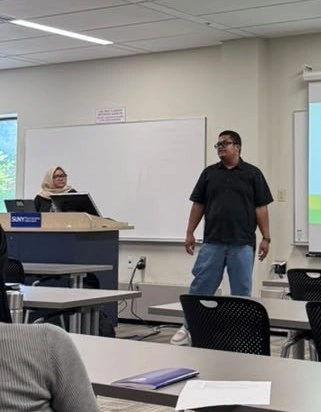
NEW YORK, United States | A lecturer from the Mining Engineering Study Program, Faculty of Engineering, Universitas Sumatera Utara (FT USU), Dr. Adri Huda, S.Si., was among the FT USU researchers who presented their research findings at the international forum “Materials for Renewable Energy and Additive Manufacturing: Next Frontiers for Recycling and Machine Learning,” held at SUNY Polytechnic Institute in New York, United States.
At the forum, Dr. Adri Huda, S.Si., presented his research entitled “Recycling of Carbon Materials for Lithium-ion Batteries and 3D-Printed Metal Manufacturing.” The research explores the potential for recovering carbon from various waste-based carbon materials in Indonesia and transforming them into value-added materials, particularly to support energy storage technologies.
As a lecturer and researcher in the Mining Engineering Study Program at FT USU, Dr. Adri Huda, S.Si., explained that Indonesia has a wide variety of carbon-based materials that could potentially be recovered and reused through appropriate technological approaches.
Several carbon sources examined in the research include biomass, pyrolysis-derived char from plastic waste processed at the USU Waste Processing and Disposal Site (TPST USU), as well as materials obtained from the recycling of spent lithium-ion batteries (LIBs) originating from electric vehicles (EVs) and electronic devices.
In his presentation, Dr. Adri Huda, S.Si., explained that waste-based carbon materials can undergo recovery and processing to achieve characteristics suitable for energy technology applications.
The research employs several approaches for material recovery, including hydrothermal, thermochemical, and hydrometallurgical processes. The selection of each method depends on the characteristics of the source material and the type of material targeted for recovery.
The research findings indicate that several recovered carbon materials demonstrate promising performance when used as energy storage materials.
Interestingly, some of the carbon-recovered materials demonstrated performance that was relatively competitive with commercial graphite, which is widely used as an anode material in lithium-ion batteries.
This finding represents one of the key aspects of the research presented by Dr. Adri Huda, S.Si. Materials previously categorized as waste may still possess significant potential to be transformed into functional materials through relatively simple and economically viable recovery processes.
“The carbon recovery approach provides an opportunity to transform waste-based materials into value-added materials. With the right technology, these materials can be recovered and reused for energy applications.”
This concept was one of the central ideas highlighted during the research presentation.
The development of this technology is also highly relevant to the concept of a circular economy, as it integrates waste management, material recovery, and resource reuse to produce new products or functional materials.
As part of the technology commercialization and research translation process, a U.S. patent application is currently being prepared as one of the anticipated outcomes of this technological development.
FT USU Research Promotes Waste Utilization for the Energy Transition
The participation of Dr. Adri Huda in this international forum provided not only an opportunity to present research findings but also a platform to introduce Indonesia's potential waste resources for the development of advanced materials and future energy technologies.
From the perspective of Mining Engineering, the development of carbon recovery technologies is closely related to efforts to broaden the paradigm of resource utilization. Materials previously regarded as residues can be reassessed as sources of secondary raw materials through technological innovation and materials engineering.
This approach is becoming increasingly relevant as demand continues to grow for materials used in lithium-ion batteries, electric vehicles, energy storage systems, and renewable energy technologies.
Through this research, Dr. Adri Huda and the FT USU research team seek to connect academic expertise with emerging technological needs, particularly in the development of sustainable materials derived from secondary resources.
The workshop also featured contributions from other FT USU researchers. Reisya Ichwani, S.Si., M.Sc., Ph.D., from the Mechanical Engineering Study Program, presented research related to carbon recovery and material development for energy applications.
Meanwhile, Akbar Gading Harahap, M.T., from the Industrial Engineering Study Program at FT USU, presented research on the potential development of metal manufacturing processes using 3D printing technology, also known as additive manufacturing.
This technology has the potential to produce a wide range of metal-based products, including specially designed components and specimens that could be developed for industrial and medical applications.
The participation of FT USU lecturers and researchers in the forum demonstrates the Faculty of Engineering's multidisciplinary contribution to the development of advanced materials, energy technologies, recycling, and advanced manufacturing.
Attended by Leaders and Researchers from SUNY Polytechnic Institute
The workshop, “Materials for Renewable Energy and Additive Manufacturing: Next Frontiers for Recycling and Machine Learning,” was facilitated by SUNY Polytechnic Institute through its Global Center for Advanced Manufacturing.
The event was attended by Prof. Winston Soboyejo, President of SUNY Polytechnic Institute; Prof. Andrew Russell, Provost of SUNY Polytechnic Institute; professors from various disciplines; researchers; postdoctoral fellows; and graduate students.
In addition to researchers from FT USU, the international forum brought together researchers from several countries.
Joseph Bioh Oti from the University of Energy and Natural Resources (UENR), Ghana, presented research entitled “Machine Learning and SCAPS Modeling for the Design of Next-Generation Perovskite Solar Cells.”
Meanwhile, Bernice Abraham from the African University of Science and Technology (AUST), Nigeria, presented “Machine Learning for the Design of Electrolytes for All-Solid-State Lithium-Ion Batteries.”
These diverse research topics demonstrate the growing integration of recycling, advanced materials, renewable energy, additive manufacturing, and machine learning in addressing emerging technological challenges and future energy needs.
Strengthening the International Presence of Mining Engineering at FT USU
The participation of Dr. Adri Huda, S.Si., a lecturer in the Mining Engineering Study Program at FT USU, in the international forum at SUNY Polytechnic Institute represents part of the Faculty of Engineering's efforts to expand its academic and research contributions at the global level.
Through carbon recovery research, Dr. Adri Huda, S.Si., and his team demonstrate that engineering approaches and appropriate technologies can create new opportunities to transform waste-based materials into value-added resources.
The research also demonstrates that the development of energy technologies does not depend solely on the discovery of new resources. It can also be advanced through the recovery, recycling, and reuse of materials that have already been used.
Moving forward, carbon recovery research is expected to focus on improving material performance, process efficiency, prototype development, and technology commercialization. These efforts are expected to contribute meaningfully to the development of the circular economy, battery technologies, sustainable energy, and future industries.
The participation of Dr. Adri Huda, S.Si., in this international academic forum represents a tangible contribution by FT USU lecturers and researchers to bringing Indonesia-based research and resource innovation to the international stage.