


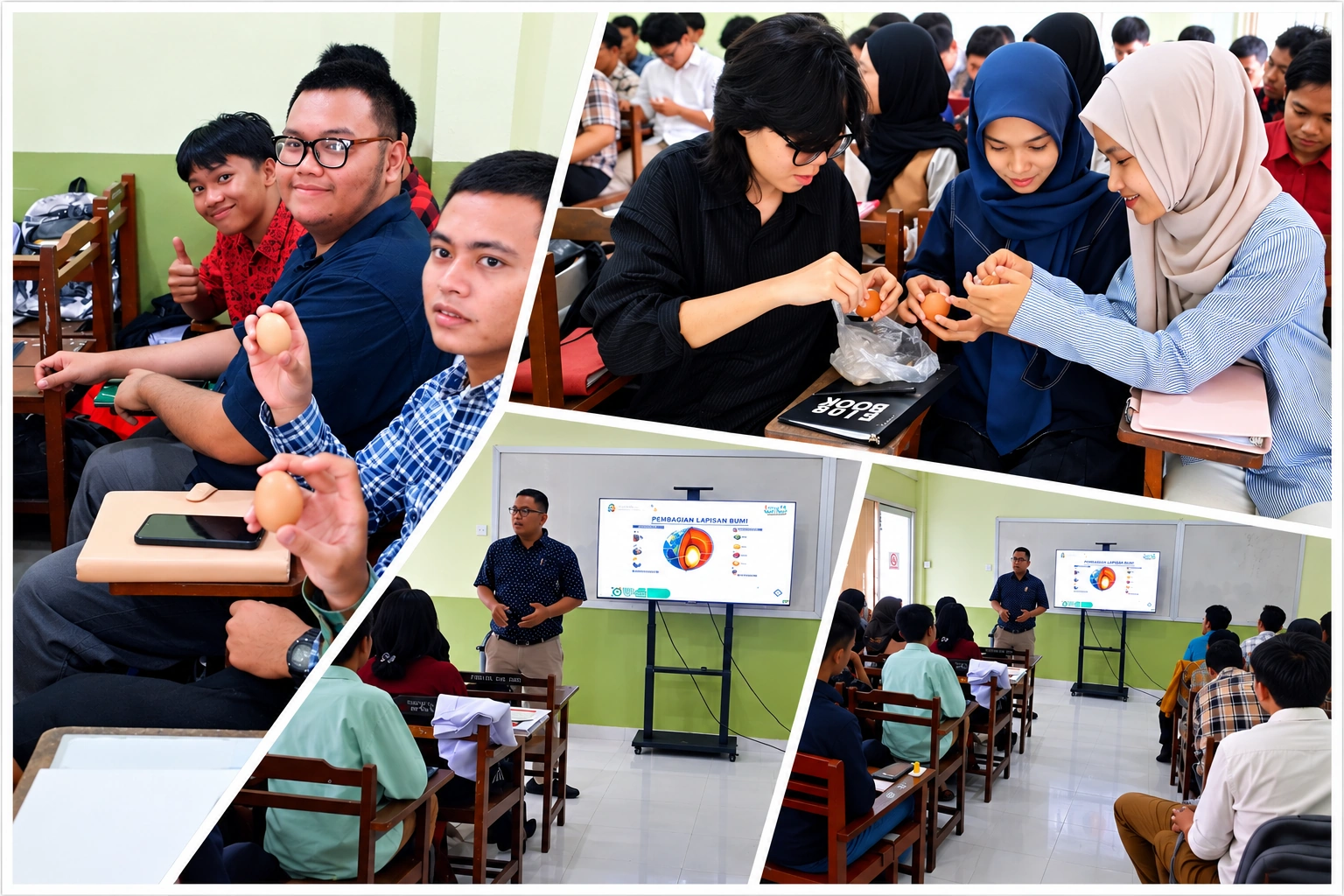
The Mining Engineering Study Program at the Faculty of Engineering, Universitas Sumatera Utara (USU), continues to develop innovative and practical teaching methods. One notable example is applied in the Basic Geology course taught by Ir. Gustam Lubis, ST., MT., Ph.D. Through an interactive approach, students are guided to understand the internal structure of the Earth using a simple yet highly effective medium: a boiled egg that is cut open.
In the practical session, each student is asked to bring a fully boiled egg. The egg is then sliced vertically or horizontally. By observing the cross-section of the egg, students can identify clear analogies to Earth’s structure. The eggshell represents the Earth’s crust, which is relatively thin and brittle. The egg white symbolizes the thicker mantle, while the yolk illustrates the dense core.
According to Ir. Gustam Lubis, ST., MT., Ph.D., this method is designed to bridge abstract geological concepts with students’ concrete experiences. “The structure of the Earth is difficult to visualize through two-dimensional textbook illustrations alone. By using an egg, students can see, touch, and compare the thickness and properties of each layer directly. This approach makes it easier to understand density, composition, and the internal dynamics of the Earth—knowledge that is highly relevant for future mining engineers,” he explained.
The interactive learning activity is not limited to visual observation. Students are also encouraged to discuss the implications of Earth’s structure for geological processes related to mining, such as the formation of mineral deposits, tectonic activity, and the characteristics of rocks at various depths. Classroom discussions continue with an analysis of how understanding Earth’s internal structure supports safer and more efficient planning of mineral exploration and extraction.
This egg analogy aligns with the principles of experiential learning that are increasingly applied in higher engineering education. By engaging the senses and involving simple physical activity, students’ conceptual understanding of basic geology becomes stronger and more lasting. This is particularly important because geology forms the foundation for Mining Engineering students in understanding rock characteristics, geological structures, and the processes that form mineral resources.
The activity has received positive responses from students in the Mining Engineering Study Program at the Faculty of Engineering, USU. Many stated that the practical approach made previously abstract material easier to understand and remember. Ir. Gustam Lubis added that similar interactive learning methods will continue to be developed in the future, utilizing other everyday objects relevant to geological and mining concepts.
Through teaching innovations such as this, the Mining Engineering Study Program at the Faculty of Engineering, Universitas Sumatera Utara, remains committed to producing graduates who not only master theory but also possess a deep and applicable understanding of geological phenomena—the essential foundation of professionalism in the mining field.