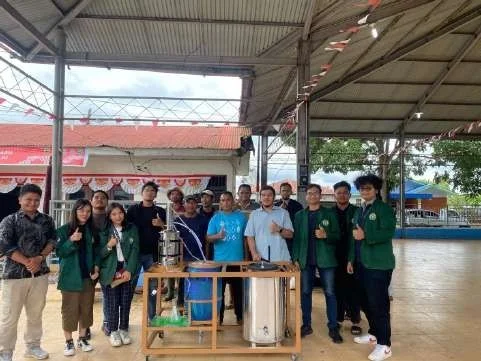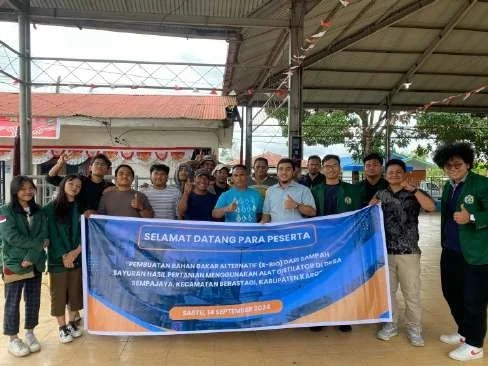
Sempajaya Village, Berastagi — The Community Service (PkM) Team, led by Dr. Ir. Bambang Trisakti, M.Si, along with other members, carried out a program titled “Production of Alternative Fuel (E-Bio) from Agricultural Vegetable Waste Using a Distillator in Sempajaya Village, Berastagi District, Karo Regency.”
This activity aims to operationalize and educate the community on the process of producing bioethanol (E-Bio) from agricultural waste through a modern approach. The main objectives of this activity include gaining a comprehensive understanding of waste-to-E-Bio processing technology, the ability to design production installations with accurate economic analysis, operational skills in running installed E-Bio processing equipment, and competence in maintenance and troubleshooting of operational issues.
Utilizing vegetable waste as raw material for E-Bio can reduce agricultural waste while producing environmentally friendly fuel that supports energy sustainability in the village. The program involved training sessions on the use of distillators and the E-Bio production process for residents of Sempajaya Village.
The activities included:
Socialization of vegetable waste utilization for alternative energy.
Training on the use of distillator equipment in the E-Bio production process.
Technical assistance and production evaluation.
The evaluation results showed successful E-Bio production and a significant potential to reduce agricultural waste.