


When a decentralized system of governance was developed in Indonesia through decentralization, city and district governments played the most strategic role in city management. Increasingly complex urban problems, such as social, economic, cultural, and physical, demand a more comprehensive solution concept. One concept that is considered relevant as a solution to the complexity of current urban problems is the idea of a friendly city. A friendly city is an ideal picture of a city where every life of the people is well accommodated, comfortable, and fair in urban spaces. The idea of a friendly city is important to discourse in relation to the anniversary of Medan City, which is more than four and a half centuries old.
A test case is needed to realize this ideal pedestrian vision. In this case, the issue raised as an example is the planning, arrangement, and management of pedestrians. The background of the selection is because the pedestrian is the level of the city that comes into contact with the community every day but still has not received serious attention.
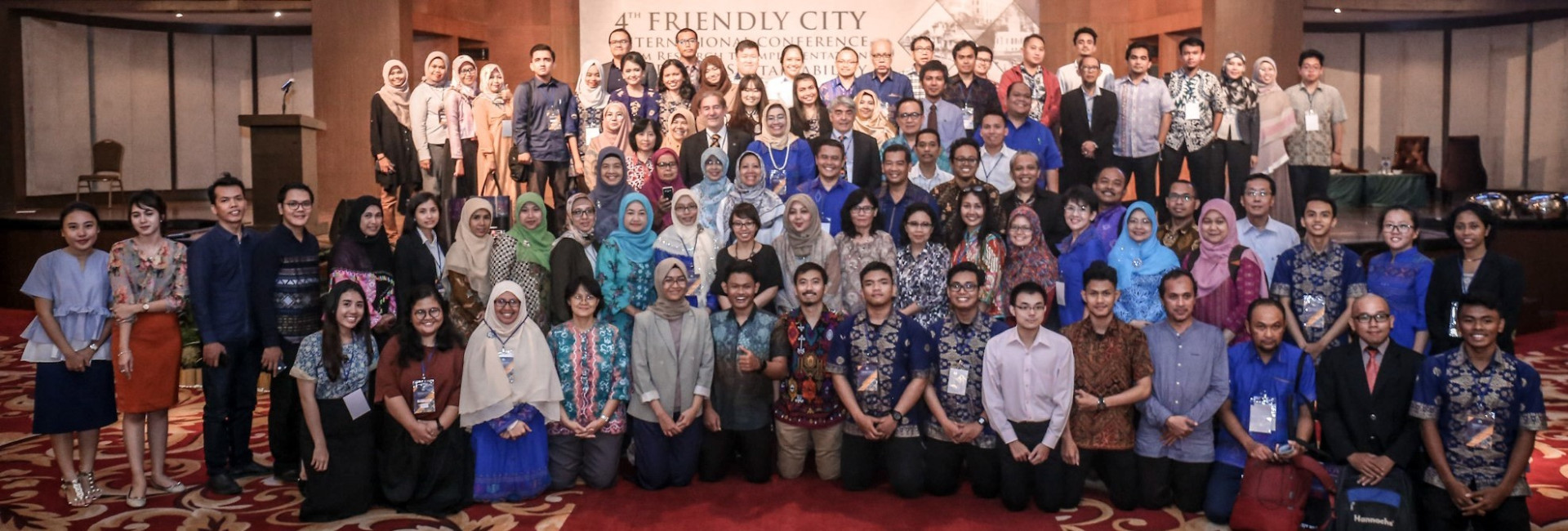
A discussion forum on friendly cities was presented at the 1st International Seminar Friendly City: Towards a Friendly City, in the context of the Decade of Architecture at the University of North Sumatra in November 2001; 2nd International Seminar Friendly City: Urban Development Management for Friendly Cities in 2003; and 3rd International Seminar Friendly City: Friendly City for Urban Tourism in 2011. As a continuation of these seminars, the Master of Architecture Study Program of the USU Postgraduate Program, in collaboration with the Medan City Government, intends to organize an International Seminar on Friendly Cities: Research to Implementation. The seminar aims to gather various positive thoughts on the management of friendly city development, especially to apply the concept to real urban problems in various parts of the world today. For this reason, it is necessary to contribute the thoughts and experiences of government practitioners, which will be combined with expert conceptual theories. Thus, a more comprehensive and applicable problem-solving framework is expected to be obtained.